
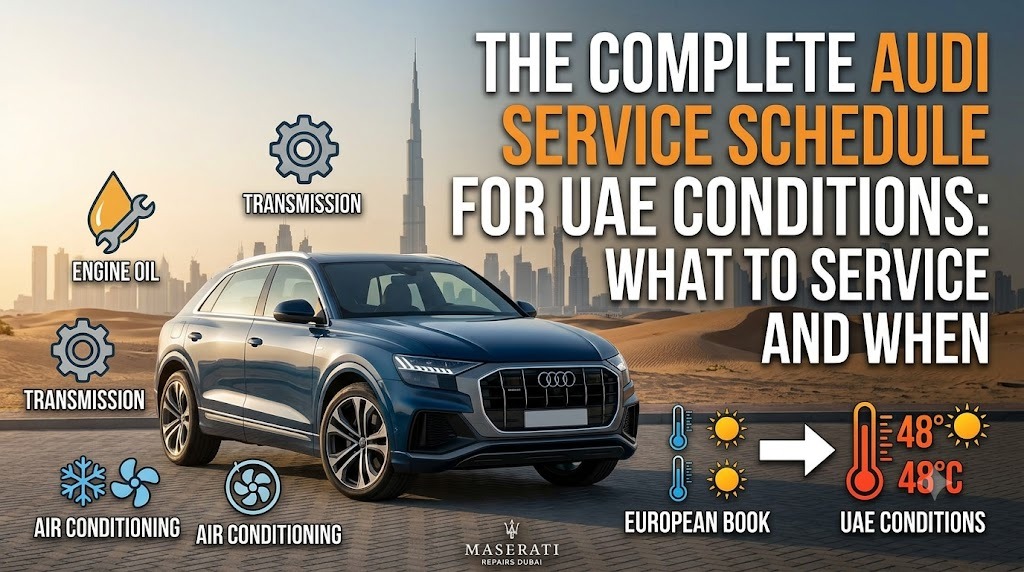
Open your Audi’s owner’s manual and you’ll find service intervals written for European driving: moderate temperatures, long highway journeys, clean air. Follow those intervals to the letter in the UAE and you’ll be under-maintaining your car. Dubai’s combination of extreme heat, fine airborne dust, high humidity near the coast, and dense stop-start traffic qualifies as “severe service” by any manufacturer’s definition — which means shorter intervals across the board.
This guide lays out a realistic, UAE-adjusted maintenance schedule for Audi models, explains why each interval differs from the European book, and highlights the items owners most often skip until it’s too late.
Engine Oil: The Foundation of Everything
European interval: up to 15,000 km or 1 year (long-life service).
UAE recommendation: 8,000–10,000 km or 6 months, whichever comes first.
Heat is oil’s enemy. Sustained high temperatures oxidise oil faster, shear down its viscosity, and reduce the protection it offers to turbo bearings, camshafts, and timing chains. Audi’s TFSI engines are particularly sensitive — many of their known issues, from timing chain wear to oil consumption, are made significantly worse by extended oil intervals. Always insist on the correct VW 502.00/504.00 specification oil, not just “any 5W-40,” because the additive package matters as much as the viscosity.
Transmission Fluid: Forget “Lifetime Fill”
S-tronic (dual-clutch): every 60,000 km in UAE conditions.
Tiptronic (conventional automatic): every 60,000–80,000 km.
Quattro rear differential and transfer case: every 80,000 km.
No fluid is a lifetime fluid in the Gulf. Transmission fluid degraded by heat is the leading cause of mechatronic failures, shift shudder, and clutch wear in Audi gearboxes here. A fluid and filter service costs a fraction of a transmission repair and is the single best-value maintenance item on this entire list.
Cooling System: Your Engine’s Life Insurance
Coolant replacement: every 4 years or 100,000 km.
Visual inspection: every service.
Pressure test: annually, ideally before summer.
Audi engines use numerous plastic cooling components — thermostat housings, water pump modules, coolant flanges — that become brittle with age and heat. A pre-summer pressure test catches weeping seals and hairline cracks before they become a roadside breakdown on Emirates Road in July. Use only G12/G13 specification coolant; mixing incompatible coolants creates gel that blocks radiator passages.
Air Conditioning: Annual Attention, Not Just When It Fails
Cabin (pollen) filter: every 10,000–15,000 km — dust clogs these far faster here.
AC performance check and condenser cleaning: annually, each spring.
Evaporator antibacterial treatment: annually if you notice any musty smell.
The AC system works harder in Dubai than almost anywhere on earth. A spring check-up — pressures, compressor draw, fan operation, and a condenser wash to clear packed sand — prevents most mid-summer failures.
Brakes: Heat Plus Traffic Equals Wear
Brake fluid: every 2 years, without exception.
Pads and discs: inspect every service; typical UAE pad life is 30,000–50,000 km depending on model and driving.
Brake fluid absorbs moisture from humid air, lowering its boiling point exactly when Dubai heat raises brake temperatures. Old fluid means a soft pedal and, in extreme cases, brake fade. Heavy models like the Q7 and Q8 wear front pads quickly in city traffic, and warped discs from repeated hard, hot stops are a common cause of steering shudder under braking.
Battery: Two to Three Years, Not Five
Heat kills batteries faster than cold. UAE battery life for most Audis runs 24–36 months, and because modern Audis carry dozens of electronic modules, a weakening battery causes bizarre symptoms — random warning lights, MMI reboots, start-stop deactivation — long before the car fails to crank. Have the battery load-tested at every service after its second year, and remember that Audi batteries must be coded to the car when replaced so the energy management system charges them correctly.
Air and Fuel Filters
Engine air filter: every 20,000 km — half the European interval, because desert dust loads filters quickly. A clogged filter costs power and fuel economy and, in the worst cases, lets fine dust past into the intake.
Fuel filter (where serviceable): per schedule, typically every 60,000 km.
Spark Plugs and Ignition
TFSI engines: every 60,000 km.
Direct-injection turbo engines are hard on plugs, and worn plugs contribute to the misfires and carbon issues these engines are known for. Ignition coils on many Audi engines are a known wear item; replacing plugs is a good time to inspect them.
Tyres, Alignment, and Suspension
Tyres age fast in the Gulf — UV and heat harden the rubber, so replace at 5 years regardless of tread depth and check pressures monthly (heat swings change pressures noticeably). An annual alignment check protects tyre life on a city full of speed humps and construction diversions, and every service should include a look at control arm bushings and links, which harden and crack in the heat.
The Items Owners Skip — and Regret
Three services get skipped more than any others, and all three produce the biggest repair bills later: transmission fluid (“the dealer said lifetime”), brake fluid (“the brakes feel fine”), and coolant system pressure testing (“there’s no warning light”). If you adopt only three habits from this article, make them these.
Putting It All Together
A well-maintained Audi is genuinely durable — 300,000 km cars are common when the schedule above is followed. The key is working with a workshop that understands both the brand and the climate, keeps digital service records, uses correct-specification fluids and OEM-quality parts, and performs the checks the quick-lube shops skip. Booking a comprehensive audi service dubai appointment with a brand specialist twice a year — once before summer, once after — is the simplest framework for keeping every item on this list on track.
Maintenance in the UAE is not about pampering the car. It’s about matching the schedule to the environment. Do that, and your Audi will reward you with the reliability and refinement it was engineered to deliver — even at 48 degrees in August.