
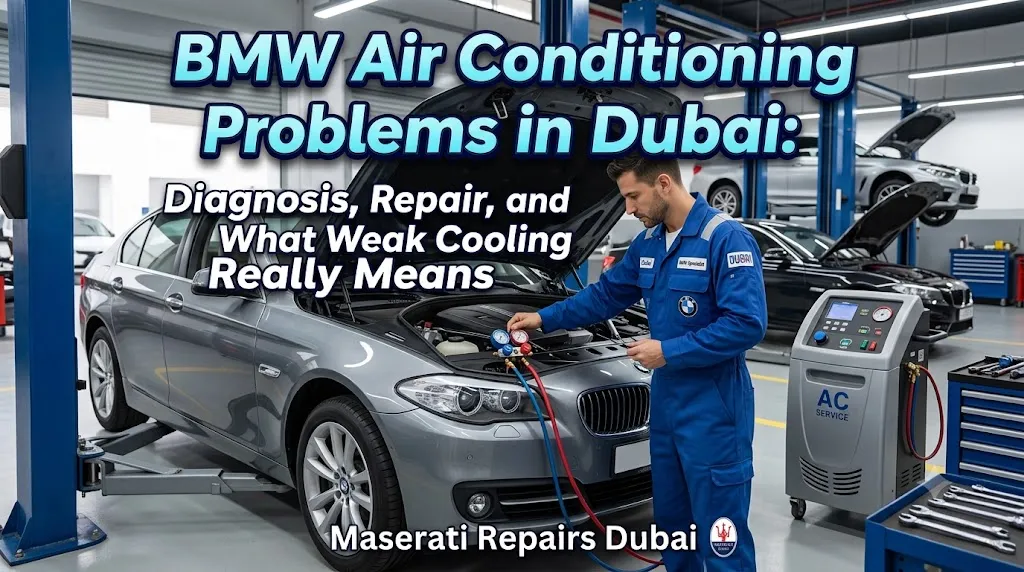
In most of the world, a car’s air conditioning is a comfort feature. In the UAE, it is closer to life support. From May through October, a BMW with weak AC is effectively undriveable, and the system runs at maximum output for hours every single day — a duty cycle far beyond anything the components experience in Europe. It is no surprise, then, that AC complaints are among the most common reasons BMWs visit workshops in Dubai, and no surprise that the failures follow patterns any experienced technician can recite from memory.
What is surprising is how often those complaints are misdiagnosed. “Weak AC” has at least eight distinct root causes on a modern BMW, ranging from a AED 150 fix to a four-figure repair, and the cheap causes are frequently overlooked in the rush to blame the refrigerant. Understanding the system helps you ask the right questions and avoid paying for the wrong repair.
How the Modern BMW AC System Differs
Recent BMWs are more complex than the simple compressor-condenser-evaporator systems of older cars. Current models use externally controlled variable-displacement compressors that modulate output continuously rather than cycling on and off. Cabin temperature is managed per-zone by electric stepper motors driving blend flaps — a 7 Series can have more than a dozen of them. Newer models have moved from R134a refrigerant to R1234yf, which requires different service equipment and costs considerably more per kilogram. Plug-in hybrids and electric BMWs use high-voltage electric compressors that double as battery cooling, where a failure is both a comfort problem and a battery-health problem.
All of this means AC diagnosis on a modern BMW is genuinely a diagnostic discipline — pressure readings, temperature deltas, compressor control currents, and flap motor positions read through BMW’s own software — rather than the old routine of “top up the gas and see.”
The Failure Patterns Dubai Produces
Condenser damage and blockage. The condenser sits at the very front of the car, first in line for every stone, every insect, and every gram of airborne sand. Fine sand packs into the gaps between the condenser and the radiators behind it, insulating the very component whose entire job is shedding heat. A partially blocked condenser produces the classic Gulf symptom: AC that is icy in the morning and mediocre by afternoon, because the system can no longer reject heat once ambient temperature peaks. Stone strikes also puncture condensers outright — the most common cause of sudden total refrigerant loss.
Slow leaks at O-rings and line joints. Every joint in the refrigerant circuit is sealed by rubber O-rings, and the same heat-ageing that hardens engine gaskets hardens these. A system losing 10–15% of its charge per year never fails dramatically; it just gets a little weaker each summer. Because refrigerant carries the compressor’s lubricating oil, chronic undercharge also quietly wears the compressor — which is how a neglected AED 300 leak becomes a AED 4,000 compressor replacement two years later.
Evaporator odour and blockage. The evaporator lives inside the dashboard, permanently damp with condensation, in a dusty environment. The result is the musty smell familiar to almost every car owner in the region, caused by microbial growth on the evaporator fins. Cabin filters clogged with fine dust compound the problem, cutting airflow dramatically. A cabin filter in Dubai is realistically a twice-yearly item, not the annual item the service schedule suggests.
Compressor and clutch failures. Running at high load for hours daily, compressors here live hard lives. Warning signs include a whine that changes with engine speed, intermittent cooling that comes and goes with a click, and metallic debris in the refrigerant circuit on inspection. A failed compressor that has shed metal internally requires a thorough system flush and usually a new condenser and expansion valve as well — debris left in the circuit destroys the replacement compressor, which is the classic story behind “the new compressor failed after three months.”
Blend flap and actuator faults. When one side of the cabin blows warm while the other is cold, or the system blows hot air regardless of setting, the refrigerant circuit is often perfectly healthy — a stepper motor or a broken flap inside the climate box has failed. On some models this is a 30-minute fix; on others, the dashboard must come out. Proper diagnosis through the climate control’s actuator test saves guessing.
Auxiliary fan problems. The electric fan behind the radiator package is what pulls air across the condenser at idle. A fan running at reduced speed — failing internally or starved by a tired control module — produces AC that works on the highway but fades in traffic, one of the most commonly misread symptoms in the region.
Why “Just Regas It” Is Usually the Wrong Answer
The refrigerant circuit is sealed. It does not consume refrigerant the way an engine consumes oil. If a system needs gas, it has a leak, and refilling without finding the leak is renting cold air by the month. Worse, repeatedly topping up masks the falling oil circulation that is wearing the compressor. A proper approach recovers and weighs the existing charge (the single most informative measurement in AC diagnosis), pressure-tests with nitrogen, finds the leak with UV dye or an electronic sniffer, repairs it, replaces the receiver-drier if the system was opened, then vacuums and recharges to the exact specified weight. Systems charged “by feel” against gauge pressure alone are routinely overcharged, which in Dubai’s ambient heat actually reduces cooling performance and stresses the compressor.
Keeping BMW AC Alive in the Gulf
A few habits measurably extend AC life here. Run the system year-round — the compressor’s seals rely on circulating oil, and systems left idle through the winter months leak more, not less. Replace cabin filters twice a year. Have the condenser and radiator package externally cleaned every couple of years, ideally with the bumper off rather than blasting water from the front, which compacts sand deeper. Treat any drop in performance as a leak until proven otherwise, and fix it while it is still an O-ring rather than a compressor. And after parking in the sun, open the windows for the first minute of driving — dumping the 70°C cabin air before asking the AC to fight it reduces peak load on every component.
When performance does drop, insist on measurement over guesswork: charge weight, vent temperatures, high and low side pressures against ambient, compressor control current. A workshop equipped with BMW’s diagnostic software and both R134a and R1234yf service stations can usually identify the true cause in under an hour. If your BMW’s cooling has faded this summer, or one zone has gone rogue, a proper assessment at a specialised bmw repair dubai facility will tell you whether you are facing a filter, a flap, a leak, or a compressor — four very different bills — before any parts are ordered.
Conclusion
Air conditioning in the UAE is not an accessory; it is the hardest-working system in the car. BMW’s implementation is sophisticated and, when maintained, extremely effective — these are cars engineered to keep an S-class-sized cabin cold in desert conditions. But the system only forgives so much neglect. Filters, condenser cleaning, prompt leak repair, and accurate charging are what separate the cars that stay icy for fifteen years from the ones limping through August on a tired compressor and a prayer. In this climate, AC maintenance is not optional spending — it is the most noticeable money you will ever spend on your car.