
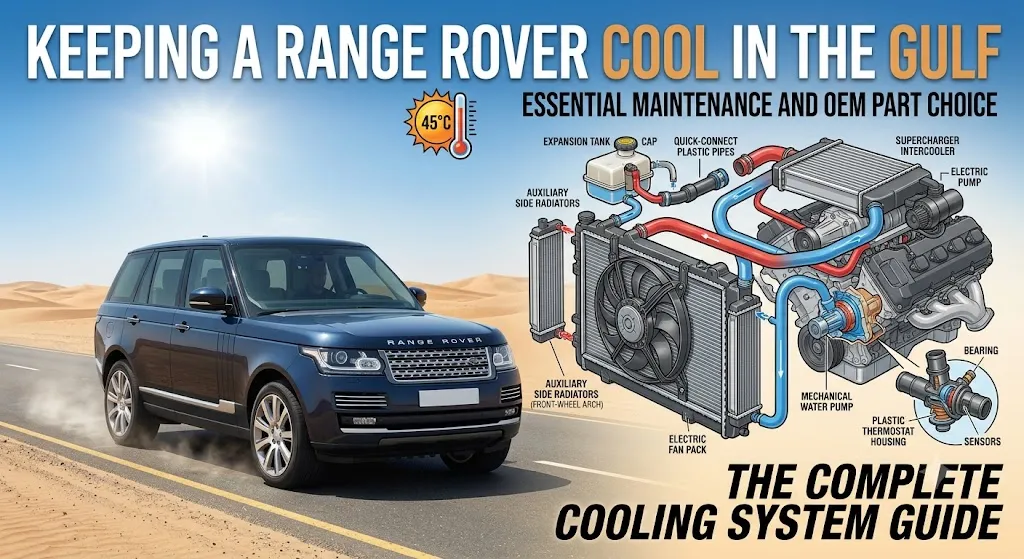
Ask any independent workshop in Dubai or Sharjah which Range Rover repairs they see most in summer, and cooling system work will be at the top of the list. Between June and September, ambient temperatures above 45°C, slow traffic, and heavy air-conditioning loads push every component of the cooling circuit to its limit. A system that copes fine in a European climate can fail suddenly here — and on modern supercharged and diesel Range Rover engines, overheating even once can mean a warped head or a damaged gasket.
This guide covers how the Range Rover cooling system works, the components that fail most often in UAE conditions, the warning signs to watch, and how to choose replacement parts wisely.
Why Range Rover Cooling Systems Work Overtime in the UAE
Modern Range Rovers — Vogue, Sport, Velar, and Evoque alike — run complex cooling architectures. The supercharged 3.0 V6 and 5.0 V8 petrol engines use a main radiator plus auxiliary radiators, an intercooler circuit with its own electric pump, electronically controlled thermostats, and multiple electric fans. Diesel variants add EGR coolers and, on many models, separate transmission oil coolers.
Every part of this network faces three UAE-specific stresses:
Sustained high ambient temperature. The system is engineered around a maximum ambient assumption; Gulf summers sit near that ceiling for months, leaving little thermal headroom for a weak component.
Airflow blockage from sand and debris. Fine sand packs into the condenser and radiator fins, insulating them exactly when maximum heat rejection is needed. A radiator can be internally perfect and still cause overheating because its face is 30% blocked.
Plastic component fatigue. Radiator end tanks, thermostat housings, expansion tanks, and quick-fit coolant pipes on these engines are plastic. Constant thermal cycling between 45°C ambient and 100°C+ operating temperature makes UAE-kept vehicles crack these parts years earlier than the global average.
The Components That Fail Most Often
Water pump. On the supercharged petrol engines, the mechanical water pump is a known service item; bearing wear and seal leaks typically appear between 80,000 and 120,000 km. A weeping pump should be replaced immediately — total failure in summer traffic escalates fast.
Thermostat and housing. The electronically controlled thermostat assemblies combine plastic housing with integrated sensors. Cracked housings and stuck-open or stuck-closed thermostats are among the most common fault codes UAE workshops see on these engines.
Radiator and auxiliary radiators. Plastic end tanks split along the crimp line. On twin-radiator setups, the auxiliary units are smaller, sit lower, and catch more road debris.
Coolant expansion tank and cap. The pressurised tank yellows, becomes brittle, and cracks — often at the seam. The cap’s pressure valve also weakens with age; a cap that vents early lowers the boiling point of the entire system. It is the cheapest cooling part on the car and the most commonly overlooked.
Electric cooling fans and fan control module. Fan failure may not show at highway speed, where airflow is natural, then cause rapid overheating the moment you hit stop-start traffic — the classic “it only overheats in traffic” complaint.
Coolant pipes and connectors. The plastic quick-connect fittings on crossover pipes and heater circuits become brittle. Many experienced UAE technicians replace nearby connectors preventively during any major coolant job.
EGR cooler (diesels). Internal EGR cooler leaks on diesel variants let coolant into the exhaust circuit — look for unexplained coolant loss with no visible leak.
Warning Signs You Should Never Ignore
- Coolant level dropping between services, even slightly. Modern sealed systems should not consume coolant.
- Sweet smell from the engine bay or air vents — coolant escaping onto hot surfaces.
- Temperature gauge climbing in traffic but recovering at speed — usually fans, airflow blockage, or a weak pump.
- White crust around hose joints, the expansion tank, or the water pump weep hole — dried coolant marks a slow leak.
- Heater blowing cold when the engine is hot — often trapped air from a leak or a failing pump.
- Coolant warning followed quickly by high temperature — stop the vehicle. On these engines, continuing to drive an overheating car for even a few minutes can convert a hose replacement into a cylinder head job.
Choosing Replacement Parts: Where Quality Is Non-Negotiable
The cooling system is one area where cheap unbranded parts are a false economy in this climate. Sensible tier choices:
- Water pumps, thermostats, sensors: genuine or original-supplier OEM only. These parts made by suppliers such as Mahle and Behr are available through the independent trade at significant savings against dealer prices.
- Radiators: OEM (Behr/Mahle, Nissens, Valeo) strongly preferred. Copy radiators use thinner cores and reject less heat — a difference invisible in Europe but decisive in a Gulf August.
- Expansion tanks, caps, and hoses: genuine or OEM. The pressure tolerances matter.
- Coolant: always the correct specification, mixed with distilled water. Mixing incompatible coolant types causes gel formation that blocks narrow intercooler circuits.
Availability in the UAE is excellent if you buy from specialists. Dedicated Land Rover parts importers stock full cooling lines for every generation, and can match part numbers to your VIN — vital because cooling components changed repeatedly within single model years. Established suppliers of range rover parts dubai drivers depend on hold water pumps, radiators, thermostats, fans, and pipe kits on the shelf, which means a summer breakdown does not have to wait a week for a dealer order.
A UAE Summer Cooling Checklist
Give your Range Rover a pre-summer cooling check every May:
- Pressure-test the system — a 20-minute workshop job that finds weak points before the heat does.
- Inspect and gently clean the radiator/condenser pack to clear sand build-up (professional cleaning with the pack separated is best; careless pressure washing bends fins).
- Check coolant strength and condition — cloudy or rusty coolant means the system needs flushing.
- Replace the expansion tank cap if it is more than four or five years old.
- Scan for stored fault codes — thermostat and fan-circuit faults often log codes before symptoms appear.
- Replace any hose or plastic connector showing whitening or hairline cracks.
Owners in the northern emirates have the same access to quality components through the Sharjah trade; long-standing stockists of range rover spare parts sharjah workshops buy from carry identical OEM cooling lines, often with same-day delivery across the UAE.
Final Word
In the Gulf, the cooling system is not just a comfort system — it is what stands between routine maintenance and a five-figure engine repair. Treat coolant loss as urgent, refresh plastic components before they fail, insist on original-supplier quality parts, and do a proper pre-summer check every year. Range Rovers handle UAE summers superbly when their cooling systems are healthy; the owners who get stranded are almost always the ones who ignored the first small warning.