
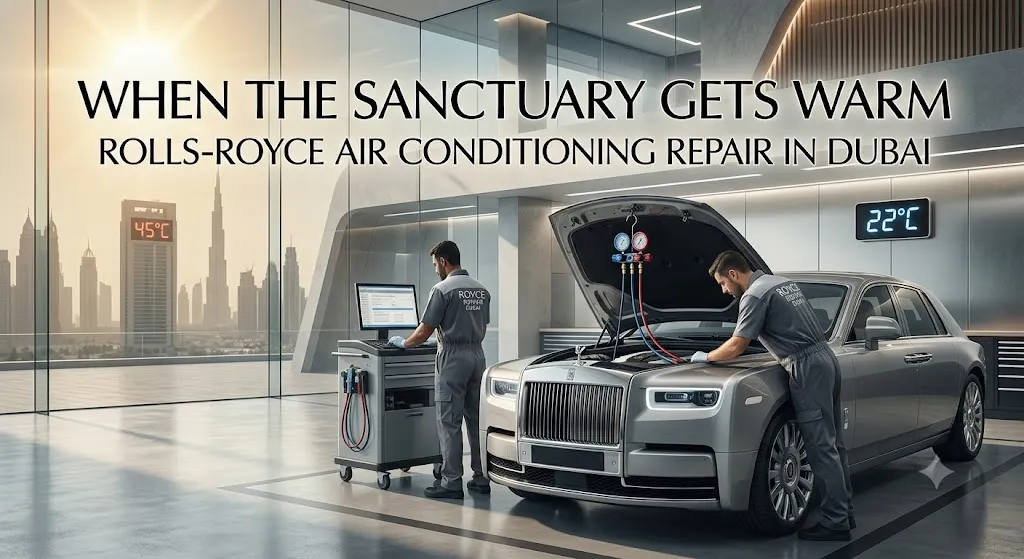
Rolls-Royce describes its cabins as sanctuaries, and nowhere is that promise tested more severely than in the UAE in August. The climate control system in a Phantom, Ghost, or Cullinan is not a bolt-on accessory; it is a core part of the car’s engineering, with multi-zone control, seat ventilation and cooling, rear-compartment air handling on long-wheelbase models, humidity management, and air filtration designed to keep the cabin serene at a precise temperature regardless of what the desert is doing outside.
When such a system weakens — and in Dubai, every automotive air conditioning system eventually does — the degradation is often gradual enough that owners adapt without realising. The car “still cools, just slowly.” The rear passengers “just need a few minutes.” By the time the system fails outright, components that could have been serviced cheaply have consumed expensive neighbours. This article explains how the system works, why the Gulf breaks it, and what a professional repair involves.
Inside the Rolls-Royce Climate System
The refrigeration circuit follows familiar principles — compressor, condenser, receiver-drier, expansion valves, evaporators — but scaled and duplicated to serve a cabin the size of a small lounge. Long-wheelbase and rear-focused models effectively carry a second air-conditioning installation for the rear compartment, with its own evaporator and blower. Layered on top:
- Electronic climate control modules managing multiple temperature zones independently
- Stepper-motor-driven air distribution flaps — dozens of them — directing air precisely
- Ventilated and cooled seats using fans and, in some seats, thermoelectric elements
- Cabin air filtration, including microfilters and activated carbon elements
- Auxiliary electric cooling fans and, on modern models, electrically driven compressor support for stop-start operation
Every one of these is a potential failure point, and the Dubai environment attacks them in a specific order.
Why Dubai Destroys Car Air Conditioning
The condenser works at its thermodynamic limit. The condenser must reject heat to the outside air. When outside air is 48°C, the temperature difference driving that heat rejection shrinks drastically, so system pressures climb and the compressor works far harder than design-average. Every component ages faster under these pressures.
Sand blocks and abrades. The condenser sits at the front of the car, and years of fine sand progressively pack its fins while abrading its surface. A condenser that is 30% blocked can no longer reject enough heat in summer, and head pressures rise to component-damaging levels. Blocked condensers are the single most common root cause of “weak AC” in the Gulf.
Heat kills seals and hoses. Refrigerant circuits are sealed by O-rings and flexible hoses. Constant heat hardens them, and the system develops slow leaks — a few grams of refrigerant a month. The system cools slightly worse each summer until one year it doesn’t cool at all. Meanwhile, low refrigerant means low oil circulation, quietly wearing the compressor.
Interior heat soak stresses everything. A cabin at 75°C after parking means the system starts every journey with an extreme pull-down task. Blower motors run flat out, evaporators swing between extremes, and stepper motors for the distribution flaps cycle constantly. Flap actuator failure — heard as clicking behind the dashboard or felt as air coming from the wrong vents — is a classic Gulf fault.
Humidity breeds evaporator contamination. Coastal humidity condensing on evaporators creates a biofilm over time. The symptom is a musty odour on start-up — unacceptable in any car, unthinkable in a Rolls-Royce.
Symptoms and What They Usually Mean
| Symptom | Likely cause |
|---|---|
| Cools well at speed, poorly in traffic | Blocked condenser or failing auxiliary fans |
| Gradual decline over months | Slow refrigerant leak |
| One zone warm, others cold | Failed distribution flap actuator or zone valve |
| Rear compartment weak, front fine | Rear evaporator/blower system fault |
| Musty smell at start-up | Evaporator biofilm, saturated cabin filters |
| Clicking behind dashboard | Stepper motor stripping or recalibrating |
| Hissing then warm air | Expansion valve fault or major leak |
| AC cuts out on the hottest days | High-pressure protection triggering — condenser or fan issue |
| Cool air but never cold | Low refrigerant or a compressor losing capacity |
The pattern to notice: almost every expensive failure begins as a cheap one. A blocked condenser becomes a dead compressor. A slow leak becomes a compressor running dry. Early attention is everything.
What Professional Repair Looks Like
A proper Rolls-Royce climate system repair is diagnostic-led and follows a sequence:
1. Electronic interrogation. Factory-level diagnostics read fault memory from the climate modules and display live data — refrigerant pressures, evaporator temperatures, flap positions, fan duty cycles. On a car with this much electronic control, guessing is malpractice.
2. Performance measurement. Vent temperatures at every outlet, pressure readings on both sides of the circuit, and condenser airflow inspection establish exactly where the system deviates from specification.
3. Leak detection done properly. UV dye and electronic sniffers locate leaks; on stubborn cases, nitrogen pressure testing finds what refrigerant testing cannot. “Just regas it” without finding the leak is not a repair — it is a scheduled repeat appointment, and every lost charge of refrigerant is an environmental cost regulations increasingly penalise.
4. Component repair with correct parts. Compressors, condensers, expansion valves, receiver-driers, and actuators must meet original specification. The receiver-drier must be replaced any time the circuit is opened — its desiccant saturates on exposure to humid air, and reusing it in Dubai guarantees moisture in the system.
5. Evacuation and precision recharge. The system is vacuumed for an extended period to boil off all moisture, then charged by weight to the gram with the correct refrigerant and the exact quantity of the correct compressor oil. Overcharging — common at quick-service shops — raises pressures and damages the compressor it was meant to help.
6. Hygiene service. Evaporator antibacterial treatment, drain cleaning, and replacement of microfilters and carbon filters restore the air quality the cabin was designed to deliver. In dusty Gulf conditions, cabin filters should be renewed at least annually — more often for cars driven daily.
7. Verification. Post-repair, vent temperatures and pressures are re-measured and documented against specification, and flap calibration routines are run so every zone responds correctly.
Maintenance That Prevents the Big Failures
Air conditioning is one system where scheduled attention genuinely prevents failures rather than merely detecting them. An annual pre-summer climate service — condenser cleaning, performance test, filter renewal, and a pressure health check — costs a fraction of a compressor and condenser replacement, and it is the single best predictor of trouble-free summers. Owners arranging comprehensive rolls royce service dubai should make sure the climate system inspection is on the worksheet every spring, not just when something has already failed.
Three habits help between services: run the system year-round (seals stay lubricated by circulating oil, and winter disuse is a leading cause of spring leaks); crack the windows for thirty seconds before setting off after sun-parking, so the system pulls down cabin temperature from 50°C instead of 75°C; and never ignore a new noise from the dashboard or a smell from the vents — both are early warnings with cheap fixes.
The engineers in Goodwood built the sanctuary. In Dubai, keeping it a sanctuary is a maintenance discipline — and one that rewards every dirham spent on doing it early and doing it right.