
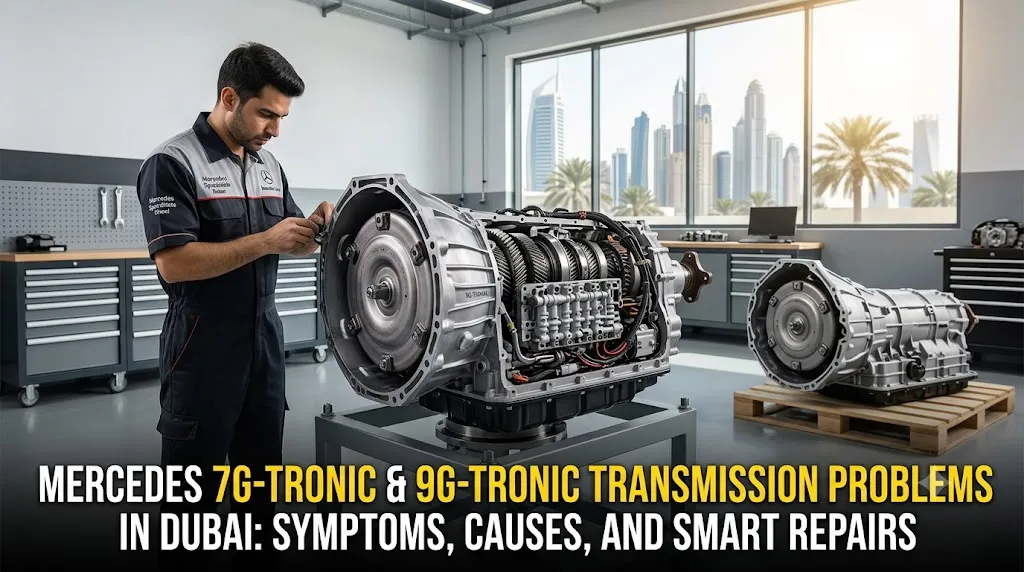
The automatic transmission is the least understood major component in any Mercedes-Benz — and in Dubai, it is also one of the most heat-stressed. The 7G-Tronic (722.9) gearbox has powered an enormous share of the C-Class, E-Class, S-Class, ML/GLE, and GLK/GLC models on UAE roads since 2004, and its successor, the 9G-Tronic (725.0), now sits in almost every new rear-drive Mercedes. Both are fundamentally excellent designs. Both also have well-documented weak points that Gulf heat and traffic bring forward by years. Understanding the symptoms early is the difference between a moderate repair and a five-figure gearbox replacement.
Why Heat Is the Transmission’s Worst Enemy
Automatic transmission fluid (ATF) does three jobs simultaneously: it lubricates, it transmits hydraulic pressure to engage clutches, and it carries heat away. Every one of those functions degrades as the fluid ages, and heat is what ages it. Chemistry gives a rough rule: for every 10°C above its ideal operating temperature, ATF’s useful life halves. Now consider Dubai: 48°C ambient summer air, transmission coolers breathing through dust-clogged condensers, and hours of stop-and-go crawling on Al Khail Road where the torque converter churns fluid into heat with little airflow to remove it. A gearbox that would run 150,000 trouble-free kilometres in Munich can start misbehaving at 90,000 in the Gulf — unless its fluid is maintained.
The 7G-Tronic (722.9): Known Weak Points
The conductor plate (electrohydraulic control unit). Inside the valve body sits a plate carrying the transmission control electronics, including the crucial Y3/8n1 and Y3/8n2 turbine and internal speed sensors. These sensors are the 722.9’s most famous failure. Symptoms are unmistakable once you know them: the car starts in 2nd gear feeling sluggish, gear display shows dashes, or the box drops into limp mode after a highway run then behaves after a restart (a classic heat-related sensor fault). The fix is a replacement conductor plate — which then must be coded (“virginised” and programmed) to the car with XENTRY, something generic workshops cannot do.
The valve body and solenoids. Aged, varnished fluid clogs the fine valve bores. Symptoms include harsh or flared 2–3 and 3–4 shifts, clunky downshifts when coming to a stop, and delayed engagement selecting Drive or Reverse from cold. Often a fluid and filter service plus adaptation reset improves this dramatically if caught early; badly worn valve bodies can be replaced or professionally recalibrated.
Torque converter shudder. A vibration between roughly 40 and 60 km/h under light throttle, feeling like driving over rumble strips, usually indicates lock-up clutch wear — frequently a consequence of degraded fluid. Early cases sometimes respond to a proper fluid exchange; advanced cases need converter replacement.
Pilot bushing leak. A small sleeve where the wiring connector enters the gearbox hardens with heat and lets ATF wick up the loom — in bad cases all the way into the transmission control module. It is a cheap part; catching it early protects an expensive one.
The 9G-Tronic (725.0): Newer, But Not Immune
The nine-speed runs lower engine revs and shifts beautifully when healthy, but Dubai workshops now see recurring themes as the fleet ages: harsh low-speed downshifts and hesitation (often addressed by software updates and adaptation resets before anything mechanical), electro-hydraulic control unit faults producing limp mode, torque converter judder on certain years, and — as always — fluid degradation accelerating all of the above. The 9G is more software-dependent than its predecessor, which makes dealer-level diagnostics and current firmware essential parts of any repair conversation.
“Lifetime Fluid” Is a Myth in the Gulf
Mercedes’ early literature described the 722.9’s fill as lifetime. Later guidance quietly reintroduced change intervals, and every experienced Gulf technician will tell you why: fluid pulled from a Dubai car at 80,000 km is typically dark, smells burnt, and carries visible friction material. The correct preventive practice here is a fluid and filter change every 60,000 km using the exact approved specification — and this detail matters enormously. The 722.9 requires different fluids by build year and plate colour (blue vs red cap generations), and the 9G-Tronic uses its own low-viscosity ATF that must never be substituted. Wrong fluid causes shudder and accelerated wear within thousands of kilometres. The service must also set the fluid level at a precise temperature via the level tube — guesswork here is as bad as no service.
Diagnosis Before Parts: The Golden Rule
Transmission symptoms overlap cruelly. A failing battery can cause shift complaints. A worn engine mount feels like harsh shifting. A misfire under load imitates converter shudder. This is why proper diagnosis — XENTRY scan of fault codes and freeze-frame data, live sensor readings, fluid inspection, and a structured road test — must precede any repair decision. The economic stakes are real: distinguishing a AED 400 speed-sensor-driven conductor plate fault from “you need a new gearbox” can save an owner twenty thousand dirhams. Any workshop offering mercedes repair dubai at a professional level should be able to show you the fault codes, explain the failure mechanism in plain language, and quote repair options from least to most invasive.
Repair Options, From Cheapest to Most Serious
The sensible escalation ladder looks like this. First, software and adaptations: update firmware where applicable and reset shift adaptations after any fluid work; the box then relearns smooth engagement over a few hundred kilometres. Second, fluid and filter service for early varnish-related complaints. Third, conductor plate replacement with coding for the classic sensor faults. Fourth, valve body overhaul or exchange for persistent hydraulic issues. Fifth, torque converter replacement for confirmed lock-up clutch failure — done with a thorough cooler flush, since debris left in the cooler destroys the new unit. Only when internal clutch packs or hard parts are worn does full overhaul or replacement enter the conversation, and at that point a quality rebuilt unit with warranty often beats both a used gearbox of unknown history and a new-unit dealer quote.
Habits That Extend Gearbox Life in Dubai
A few free behaviours pay compound interest. Let the drivetrain warm for the first few minutes before demanding full power — fluid needs temperature to protect properly, even here. Come to a complete stop before switching between Reverse and Drive. In long traffic jams, Neutral for extended standstills reduces converter heat. Keep the front of the car clean: a condenser and radiator packed with dust raises every fluid temperature on the vehicle. And respect the 60,000 km fluid ritual as non-negotiable.
The Bottom Line
Neither the 7G-Tronic nor the 9G-Tronic deserves a bad reputation — they are sophisticated gearboxes whose known weaknesses are well mapped and, caught early, economically repairable. In Dubai’s heat, the difference between a transmission that lasts 300,000 km and one that fails at 120,000 almost always comes down to two things: disciplined fluid maintenance, and responding to the first symptom instead of the fifth. Give the gearbox those two courtesies, and it will return the smooth, silent service Mercedes intended.