
Maserati Transmission Problems: Rough Shifting and Gearbox Faults
A Ghibli that thumps into second on a cool morning and then behaves perfectly by the time it reaches Business Bay is telling you something very specific. This guide is for Maserati owners in the UAE who want to understand Maserati transmission problems properly — which gearbox is in the car, what each symptom means and what actually fixes it.
Quick answer
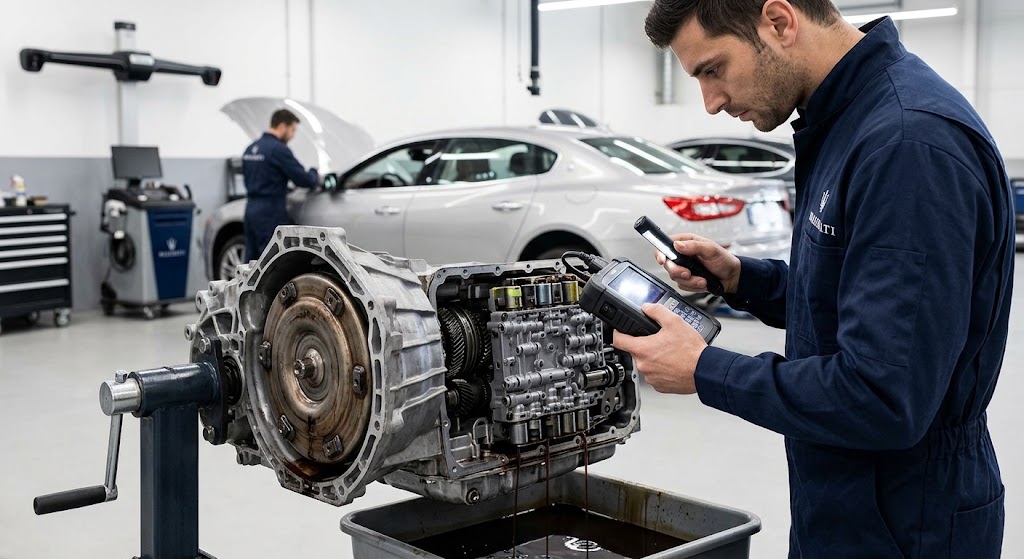
Most Maserati transmission problems come from degraded fluid, worn mechatronic solenoids, outdated shift software or clutch wear on robotised gearboxes. Symptoms include harsh 1–2 shifts, a delay when selecting Drive, slipping under load and shudder at light throttle. Correct diagnosis starts with a fluid inspection and a live gearbox data read.
Key takeaways
- Harsh 1–2 shifts, delayed engagement and low-speed shudder are the three earliest signs of a Maserati gearbox fault.
- Degraded transmission fluid causes more harsh shifting on Dubai cars than worn clutch packs do.
- The ZF 8-speed and 6-speed automatics still need fluid and filter servicing despite being described as sealed for life.
- Mechatronic solenoids, speed sensors and a leaking connector sleeve are regularly misdiagnosed as complete gearbox failure.
- A rebuild at a specialist workshop is almost always cheaper than a replacement unit fitted by an authorised dealer.
Which gearbox does your Maserati have?
Four gearboxes cover almost every petrol Maserati on UAE roads, and each one fails in its own way. Knowing which unit sits under your car decides whether a fluid service, a solenoid, a clutch pack or a software reset is the sensible first step.
The eight-speed torque converter automatic — the Maserati ZF 8 speed fitted to the Ghibli, Levante, Grecale and later Quattroporte — shares its hardware with several European manufacturers, but Maserati runs its own torque limits and shift maps. That matters, because a general gearbox shop can program one correctly and still leave the car shifting badly.
Older GranTurismo and GranCabrio models use either the ZF six-speed automatic or a robotised single-clutch manual badged DuoSelect or MC Shift. Robotised cars behave like a manual with a computer working the clutch, so they are judged by completely different standards.
| Gearbox | Models | Typical issues |
|---|---|---|
| ZF 8-speed automatic | Ghibli, Levante, Grecale, Quattroporte (2013 on), GranTurismo (2023 on) | Harsh 1–2 shifts, solenoid wear, fluid breakdown, drifted adaptations |
| ZF 6-speed automatic | GranTurismo, GranCabrio, automatic Quattroporte (2008–2012) | Lock-up shudder, valve body wear, delayed engagement |
| DuoSelect / MC Shift robotised manual | Quattroporte DuoSelect, GranTurismo MC Shift, Coupé and Spyder | Clutch wear, hydraulic pump and accumulator faults, actuator sensor errors |
| 8-speed dual clutch | MC20 | Heat stress on clutch packs, calibration faults, cooling restrictions |
Common symptoms of Maserati transmission problems: harsh shifts, delays and slipping
Most Maserati transmission problems announce themselves through feel long before a warning light appears. Harsh shifts, a pause before the car moves, slipping under load and a low-speed shudder are the four complaints we hear most often.
The pattern matters more than the symptom itself. A thump into second that fades after ten minutes points towards fluid and adaptations; a thump that worsens as the car heats up usually means hydraulic pressure is falling away. Owners who contact us about Maserati Ghibli transmission problems nearly always describe the first version.
| Symptom | When you notice it | Likely cause |
|---|---|---|
| Harsh or thumping 1–2 upshift | First ten minutes, cold engine | Degraded fluid, drifted adaptations, lazy solenoid |
| Delay selecting Drive or Reverse | Any time, worse when hot | Low line pressure, valve body wear, mechatronic fault |
| Flare or slip between gears | Hard throttle, uphill ramps | Worn clutch packs, pressure loss |
| Shudder at light throttle | Steady 1,200–1,800 rpm | Torque converter lock-up clutch |
| Jerking while crawling | Heavy traffic | Lock-up cycling or robotised clutch wear |
| Gearbox warning, limp mode | Suddenly, car stuck in one gear | Sensor, solenoid or wiring fault stored in the control unit |
Transmission fluid: the most ignored service item
Fluid condition sits behind more Maserati gearbox problems than any other single factor. The phrase "filled for life" describes the design life of the vehicle, not the life you expect from a car you plan to keep.
Automatic transmission fluid carries friction modifiers that control how smoothly each clutch pack grips. Heat oxidises those additives, the fluid darkens, and the pressures the gearbox has learned no longer produce the same result — so it compensates with more pressure, which you feel as a thump.
When we drain a neglected unit, the fluid comes out dark and smells scorched, and the pan filter is loaded with clutch material. A fluid and filter service still helps at that stage, but it cannot bring back friction material that has already worn away.
Warning
If the car is slipping, flaring between gears or dropping into limp mode, stop driving it. Every extra kilometre circulates friction material through the hydraulic circuit and turns a fluid and solenoid job into a full rebuild.
Mechatronic unit, valve body and sensor faults
When the fluid is healthy and the car still shifts badly, the mechatronic unit becomes the main suspect. It combines the valve body, solenoids, pressure sensors and control electronics in one assembly, and it is where most electrical gearbox faults start.
Solenoids wear, stick or react slowly, so pressure arrives late or far too hard. On ZF units we also check the connector sleeve where the loom passes through the case — fluid weeping into that connector causes erratic shifting and sensor codes that look like catastrophic failure but are not.
That misdiagnosis is common. Cars reach us having been quoted for a replacement gearbox elsewhere when the real fault was a leaking sleeve, a speed sensor or chafed wiring inside the sump.
How we diagnose a gearbox fault
- Read every module, not only the gearbox. Engine torque faults, brake switch errors and weak battery voltage all change shift behaviour.
- Inspect the fluid at operating temperature. Level, colour and smell tell us more in five minutes than a code reader does.
- Log live data on the road. Line pressure, turbine speed, slip values and lock-up duty while we repeat your exact complaint.
- Decide before anything is opened. Adapt, repair the component or strip the unit — with the reasoning explained to you first.
Software adaptations and updates
Maserati gearboxes learn. The control unit continually adjusts clutch fill times and pressures to match wear, and those learned values are what make shifts feel smooth.
Replace the fluid, fit a solenoid or disconnect the battery carelessly, and those adaptations no longer match the hardware beneath them. Resetting them and driving a structured relearn cycle often transforms a car that felt rough, without one part being replaced.
Updated calibrations exist for several models and target specific complaints such as low-speed hesitation. Software has limits, though: when a stored Maserati gearbox fault keeps returning after a reset, something mechanical or hydraulic is causing it.
Robotised gearbox clutch wear on DuoSelect and MC Shift models
On DuoSelect and MC Shift cars, some jerkiness is normal behaviour and clutch wear is the real question. The computer operates a conventional single clutch, so it wears exactly as a manual clutch does — quickly in traffic, slowly on open roads.
We read clutch position and wear values with factory-level diagnostics instead of guessing. High engagement figures, a hydraulic pump cycling more often than it should, or a car that struggles to pull away cleanly on a ramp usually point to a clutch and sometimes an accumulator together.
Driving style changes the outcome here more than anything else. Holding the car against the clutch at a parking barrier wears it fast; lifting off the throttle briefly as each shift happens makes the gearbox noticeably smoother.
How Dubai heat and traffic stress the gearbox
Heat is the biggest enemy of an automatic gearbox, and Dubai supplies it from two directions at once. Ambient temperatures above 45°C reduce how much heat the cooler can shed, while stop-start traffic keeps the torque converter slipping rather than locked.
A gearbox cruising at 120 km/h on Sheikh Zayed Road is barely working. The same gearbox crawling the final three kilometres towards it at 06:45 is doing its hardest work with the least cooling airflow.
Short journeys cause their own damage. A ten-minute run to the mall never brings the fluid to a stable temperature, which is why some low-mileage Dubai cars have worse fluid than high-mileage ones.
The Dubai factor
Sand and heat work together here. Fine dust blankets the radiator and cooler matrix until airflow drops, fluid temperature climbs and the gearbox starts shifting defensively to protect itself. A car that shifts harshly in August and acceptably in January is often telling you about cooling, not clutches.
Repair, rebuild or replace?
Three outcomes are possible, and the honest answer depends on what inspection reveals. A sensor, solenoid or leaking sleeve is a targeted repair; worn clutch packs inside a sound case call for a rebuild; damaged shafts, a failed pump or a cracked housing push you towards a replacement unit.
A targeted repair
Covers solenoids, speed sensors, the connector sleeve, cooler lines and fluid. Suitable while pressures remain correct and the clutches still hold under load.
A rebuild or replacement
Replaces clutch packs, seals, bearings and valve body inside your original unit. We price a rebuild against a replacement gearbox before any work begins.
Cost is driven by gearbox type, how far the damage has spread and which components you choose — genuine OEM, premium aftermarket or inspected used parts are all available, and that decision stays with you. Maserati transmission repair in Dubai at an independent specialist costs a fraction of authorised dealer pricing for identical work, which is why we quote after inspection rather than over the phone.
Protecting your transmission
Gearbox longevity is decided mainly by heat management and fluid intervals, both of which sit within your control. These habits cost very little and prevent most of the faults described above.
- Service the fluid and filter to a schedule, not when symptoms appear.
- Give the car a minute of gentle running before heavy throttle on cool mornings.
- Come to a complete stop before selecting Reverse or Drive.
- Keep the radiator and cooler stack clean, particularly after a sandy spell.
- Have any new delay, noise or jerk checked while it is still intermittent.
Book diagnosis early. Most of the expensive rebuilds carried out at Maserati Repairs Dubai began as a small symptom the owner lived with for months.
Pro tip from our technicians
Judge the fault by temperature. If shifts are clean for the first twenty minutes and deteriorate afterwards, the cause is heat related — cooling, fluid or pressure. If the car improves as it warms up, you are usually looking at fluid condition and adaptations instead.
Frequently asked questions
What are the signs of Maserati transmission problems?
The clearest signs are a harsh or thumping 1–2 upshift, a delay of a second or more when selecting Drive or Reverse, slipping or flaring between gears, shudder at light throttle around 1,200–1,800 rpm, and a gearbox warning that drops the car into limp mode. Burnt-smelling or dark fluid confirms it.
Does the Maserati ZF gearbox need fluid changes?
Yes. Although the ZF 8-speed and 6-speed units are often described as sealed for life, the fluid and filter should be changed periodically, and sooner in Dubai conditions. Heat breaks down the friction modifiers, which changes shift pressure and wears the solenoids. Skipping this service causes most of the gearbox faults we see.
Why does my Maserati shift harshly?
Harsh shifting usually comes from degraded fluid, worn valve body solenoids or shift adaptations that have drifted out of range. The gearbox applies the wrong pressure for the clutch pack it is engaging, so the change arrives as a thump. A fluid service and a fresh adaptation reset resolve many cases.
Can transmission software updates fix shifting problems?
Sometimes. Updated gearbox software corrects shift timing and pressure strategies, and relearning adaptations after a fluid change often smooths out a car that shifts roughly. Software cannot repair worn clutch packs, a failed solenoid or a leaking valve body, so we always confirm mechanical and hydraulic condition first.
How long does a Maserati gearbox last?
A well-maintained ZF automatic in a Ghibli, Levante or Quattroporte will comfortably outlast several sets of tyres and often reaches very high mileage. Fluid condition decides the outcome more than age. Robotised DuoSelect and MC Shift gearboxes need clutch replacement far sooner, especially on cars used mainly in city traffic.
Is a transmission rebuild cheaper than replacement?
Usually yes. Rebuilding keeps the original housing and replaces only the worn clutch packs, seals, solenoids and bearings, so you pay for parts and labour rather than a complete unit. Replacement makes sense when the case, pump or shafts are damaged. We quote both options after stripping and inspecting the gearbox.
Why does my Maserati jerk in traffic?
Low-speed jerking points to the torque converter lock-up clutch cycling on a worn friction surface, or to clutch adaptation errors on robotised gearboxes. Stop-start crawling on Sheikh Zayed Road keeps the gearbox in its hardest-working range. We check fluid condition and live lock-up data before assuming internal wear.
Can an independent garage repair a Maserati gearbox?
Yes, provided it has factory-level diagnostics, the correct fluid specification and experience with ZF and robotised units. Maserati Repairs Dubai carries out gearbox diagnosis, fluid and mechatronic work, adaptation resets and full rebuilds, with free pickup and drop-off anywhere in Dubai and pricing well below authorised dealer rates.