
Maserati Check Engine Light: 10 Common Causes and What to Do
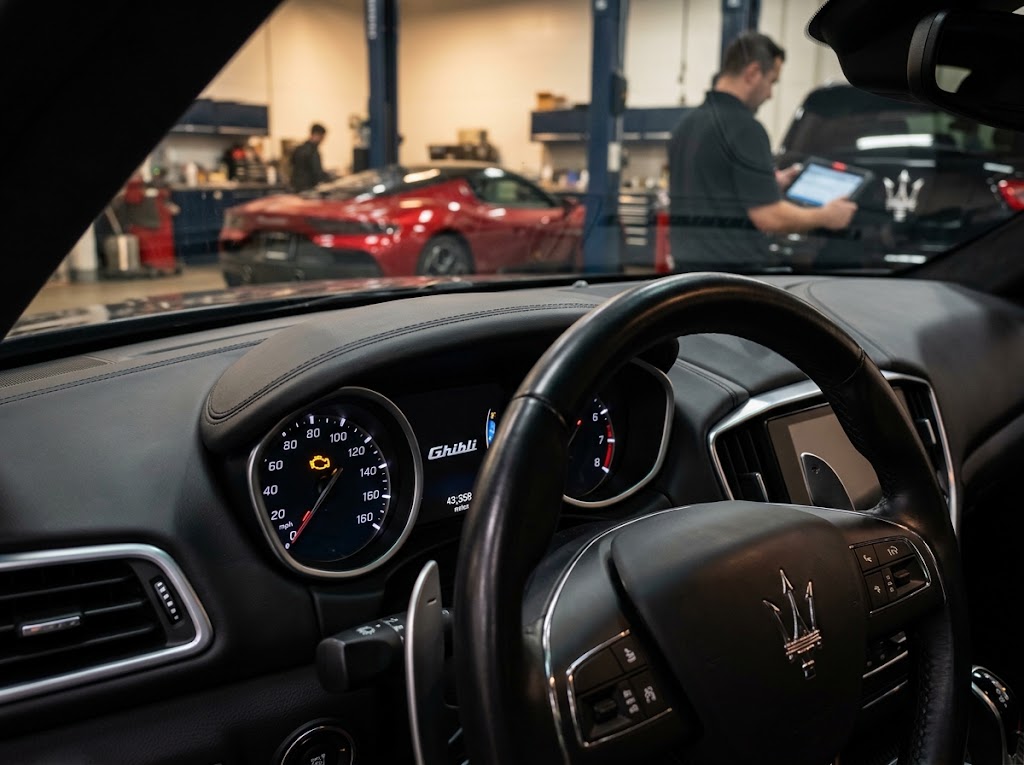
The amber engine symbol has just lit up, perhaps minutes after refuelling or halfway along Sheikh Zayed Road. This guide is for Ghibli, Levante, Quattroporte, GranTurismo, Grecale and MC20 owners who want to know what a Maserati check engine light means, what triggers it and what to do next.
Quick answer
A Maserati check engine light means the engine computer has stored a fault affecting emissions, ignition, fuelling or boost. A solid light is rarely an emergency, but book a diagnostic within days. A flashing light signals an active misfire that can overheat the catalytic converters, so slow down, stop safely and avoid driving until it is checked.
Key takeaways
- A steady engine light usually points to a sensor, ignition or leak fault that should be diagnosed within days, not weeks.
- A flashing light means an active misfire, and every extra mile risks turning a coil replacement into a catalytic converter replacement.
- Worn spark plugs and cracked ignition coils are among the faults we trace most often on the twin-turbo V6.
- Clearing the code with a cheap scanner erases the freeze-frame evidence a technician needs and leaves the fault in place.
Solid vs flashing check engine light: what does each mean?
A solid light means a fault is stored but the engine is still being managed safely. A flashing light means a misfire is happening right now.
Your Maserati's engine computer constantly tests its ignition, fuelling, emissions and boost systems. When one of those tests fails, often on two drives in a row, the light comes on and the computer saves a fault code plus a snapshot of conditions at that moment.
Solid amber
A fault is logged, but nothing is about to break. Book a diagnostic within days.
Flashing amber
This is the flashing check engine light Maserati technicians treat as urgent: unburnt fuel is reaching the catalysts. Ease off and stop safely.
Warning
Driving on a flashing light can overheat the catalytic converters until their internal honeycomb breaks up, restricting the exhaust and loading the turbos with back-pressure. A failed coil is a modest repair; a melted catalyst is not.
Is it safe to drive with the Maserati check engine light on?
With a steady light and a car that drives normally, a calm trip to a workshop is generally fine. Stop and arrange recovery if any of these appear alongside it:
- The light flashes or flickers under load
- Power drops or the car will not rev freely (limp mode)
- Engine temperature or oil pressure warnings
- A strong smell of fuel or burning
- Heavy shaking at idle
A steady light still needs attention. Owners often tell us at Maserati Repairs Dubai that the light had been on 'for a few weeks' and the car felt fine, yet a vacuum leak or lazy oxygen sensor had been fouling plugs and stressing the catalysts the whole time.
What causes a Maserati check engine light? The 10 most common faults
Ten faults account for most of the lights we see. They are listed roughly in the order we check them.
1. Loose or worn fuel cap
A cap left loose after refuelling, or one with a perished seal, lets vapour escape. The evaporative system pressure-tests the tank and reports it as a leak.
2. Oxygen sensors
Each cylinder bank has sensors before and after its catalyst. Heat slows their response with age, and a tired upstream sensor skews fuelling, quietly fouling plugs and catalysts.
3. Ignition coils
Each cylinder has its own coil, and engine-bay heat cracks the bodies and boots until the spark tracks to earth. Our first test is swapping the suspect coil to another cylinder to see whether the misfire follows it.
4. Spark plugs
The twin-turbo V6 in the Ghibli, Levante and Quattroporte works its plugs hard. A Maserati Ghibli check engine light with a single-cylinder misfire often gets a new coil while worn plugs stay in, and the misfire simply moves.
5. MAF and airflow sensors
Fine dust, oil from over-oiled performance filters or a split intake duct corrupts the airflow reading. Expect hesitation and lean or rich fuelling codes.
6. Catalytic converter
Catalyst codes are usually a consequence, not a cause. Before condemning a converter, we check the downstream sensor, because a lazy sensor triggers the same code.
7. EVAP system leaks
Beyond the cap sit a purge valve, a charcoal canister and several hoses. We smoke-test the system to find leaks too small to see.
8. Turbo and boost faults
On the twin-turbo V6, the MC20's Nettuno V6 and the four-cylinder Grecale, split intercooler hoses, loose clamps and sticking wastegate actuators cause underboost codes and limp mode. Older naturally aspirated V8 GranTurismos and GranCabrios avoid this one.
9. Vacuum leaks
Hardened crankcase ventilation hoses or a split intake boot let in unmetered air. Lean codes on both banks at once usually point to one shared leak.
10. Low battery voltage
A weak battery makes control modules log a confusing spread of faults. We test the battery and charging system before chasing any electrical code.
What do common Maserati fault codes mean?
Maserati fault codes follow the standard OBD-II format. A code names the system that failed a test, not the part to replace.
| Code range | System | Common Maserati cause |
|---|---|---|
| P0010–P0025 | Camshaft timing | Low or degraded oil, sticking timing solenoid |
| P0100–P0113 | Airflow and intake temperature | Contaminated sensor, split intake duct |
| P0130–P0167 | Oxygen sensors | Ageing sensor, heat-damaged wiring |
| P0171–P0175 | Fuel trim (lean/rich) | Vacuum or crankcase hose leak |
| P0234 / P0299 | Overboost / underboost | Split boost hose, wastegate actuator |
| P0300–P0308 | Engine misfire | Coil, spark plug or injector |
| P0420 / P0430 | Catalyst efficiency | Earlier misfire damage or lazy downstream sensor |
| P0440–P0457 | EVAP system | Fuel cap, purge valve, cracked hose |
| P0560–P0563 | System voltage | Weak battery or charging fault |
Codes beginning P1, plus B, C and U codes held in other modules, are manufacturer-specific and need Maserati-capable equipment to read properly.
Why is a generic code reader not enough for a Maserati?
A basic reader shows the generic emissions code and nothing more. It cannot see other modules, run component tests or display the live data that explains why the fault happened.
Take P0300, random misfire. Dealer-level equipment shows which cylinders are misfiring, the fuel trims at that moment and whether boost was on target. That is the difference between guessing at six coils and replacing the one that failed.
Pro tip from our technicians
Don't clear the code before your appointment, as that wipes the freeze-frame record. Instead, photograph the dashboard and note what the car was doing: cold start, hard acceleration, idling in traffic or just after refuelling.
How does a specialist diagnose a Maserati engine warning light?
A proper diagnosis pairs a full system scan with physical tests that prove which part has failed. Reading the code takes minutes; confirming the cause is the real work.
At Maserati Repairs Dubai we scan every module, review the freeze-frame data, then watch live readings on a road test: fuel trims, sensor switching, misfire counters, boost and voltage under load. Smoke tests, coil swaps and plug inspections confirm the culprit before we quote.
Misdiagnoses we correct regularly
- Catalysts replaced when a lazy sensor or old misfire was the real cause
- Coils swapped repeatedly while worn plugs overloaded them
- Airflow sensors fitted to cure what was really a vacuum leak
For the repair itself, you choose genuine OEM, premium aftermarket or inspected used parts. A Maserati diagnostic in Dubai at our workshop costs up to 70% less than authorised dealer rates; WhatsApp us your model for an exact figure.
Does Dubai heat cause check engine lights?
Not directly, but 45°C+ summers accelerate the failures that do. Coils, hoses, sensors and batteries all age faster in a hot engine bay.
Picture a Levante crawling along Sheikh Zayed Road on an August evening, air conditioning at full load and almost no air moving through the engine bay. Repeated heat cycles like that harden boost and vacuum hoses until they split.
The Dubai factor
Short mall trips rarely let the engine reach full temperature or the battery recharge after an air-conditioned start. Add fine sand clogging the air filter and coastal humidity creeping into connectors, and you have the conditions behind many a Maserati check engine light we diagnose.
What should you do when the light comes on? Step-by-step
Check whether the light is solid or flashing, look for other warnings and leave the code stored. Then book a proper diagnosis.
- Read the light. Solid means book soon; flashing means ease off immediately.
- Scan the gauges. Temperature, oil pressure and cluster messages show whether the engine is at risk.
- Stop if it flashes. Exit safely, switch off and arrange recovery rather than limping home.
- Check the fuel cap. If the light followed a fuel stop, tighten the cap until it clicks and drive normally for a few days.
- Note the details. Record when it appeared, how the car felt and any rough idle; a short video helps.
- Drive gently. No full-throttle runs or long trips until the cause is known.
- Book the diagnostic. WhatsApp a photo of the dashboard and we will arrange free pickup from your home or office anywhere in Dubai.
Frequently asked questions
Why is my Maserati check engine light on?
Your Maserati's engine computer has detected a fault it cannot correct on its own. The most common culprits are worn spark plugs, failing ignition coils, oxygen sensors, vacuum or EVAP leaks, boost faults and low battery voltage. The light only tells you a fault exists; a full diagnostic scan of every module is needed to pinpoint which one.
Can I drive my Maserati with the check engine light on?
Usually yes, for a short distance, if the light is steady and the car drives normally. Keep speeds moderate, avoid hard acceleration and get it diagnosed within a few days. If the light flashes, the car loses power, the temperature climbs or you smell fuel, stop driving and arrange recovery instead.
What does a flashing check engine light mean on a Maserati?
A flashing light means the engine is misfiring badly enough to damage the catalytic converters. Unburnt fuel is entering the exhaust and burning inside the catalysts, which can overheat and melt them. On a Maserati the usual causes are a failed ignition coil, a worn spark plug or an injector fault. Ease off, stop safely and do not keep driving.
Will the check engine light reset itself?
Sometimes, but only if the fault genuinely disappears. Many emissions faults, such as a loose fuel cap, switch the light off after several clean drive cycles. Hard faults like a failed coil or sensor keep it on. Even when the light goes out, the code usually remains stored for a while, so a scan can still show what happened.
Can a loose fuel cap trigger the light?
Yes. A cap that is loose, cross-threaded or has a perished seal lets fuel vapour escape, and the evaporative emissions system reports it as a leak. Tighten the cap until it clicks, then drive normally for a few days. If the light stays on, the leak is likely elsewhere, such as a purge valve or cracked EVAP hose.
Can a normal OBD scanner read Maserati codes?
Only partly. A generic OBD scanner reads the standard emissions codes from the engine module, which gives a starting point. It cannot see Maserati-specific codes, faults stored in the transmission, body or other modules, or detailed live data such as per-cylinder misfire counts and requested versus actual boost. Those need dealer-level diagnostic equipment.
How much does a Maserati diagnostic cost?
The cost depends on how deep the investigation needs to go. A full module scan with live-data review is the starting point, while intermittent faults may need smoke testing, boost leak testing or road testing. At Maserati Repairs Dubai, diagnostics cost up to 70% less than authorised dealer rates. Send us a WhatsApp message with your model and symptoms for an exact quote.
Why did my check engine light come on after refuelling?
Most often because the fuel cap was not tightened fully, so the EVAP system detected a vapour leak on its next self-test. Less often, a sticking purge valve floods the intake with vapour after filling, or the fuel was of poor quality. Check the cap first; if the light persists after a few drives, have the codes read.