
Maserati Oil Leak Repair in Dubai — Dealer-Level Work, Up to 70% Cheaper
Valve cover gaskets, oil cooler lines, front and rear main seals, oil pan gaskets and turbo oil feed lines — we find the true source of the leak with UV dye and pressure testing, then fix it properly. Every non-electric Maserati is welcome: Ghibli, Quattroporte, Levante, Grecale, GranTurismo, GranCabrio, MC20 and the classics. Free pickup and drop-off anywhere in Dubai.
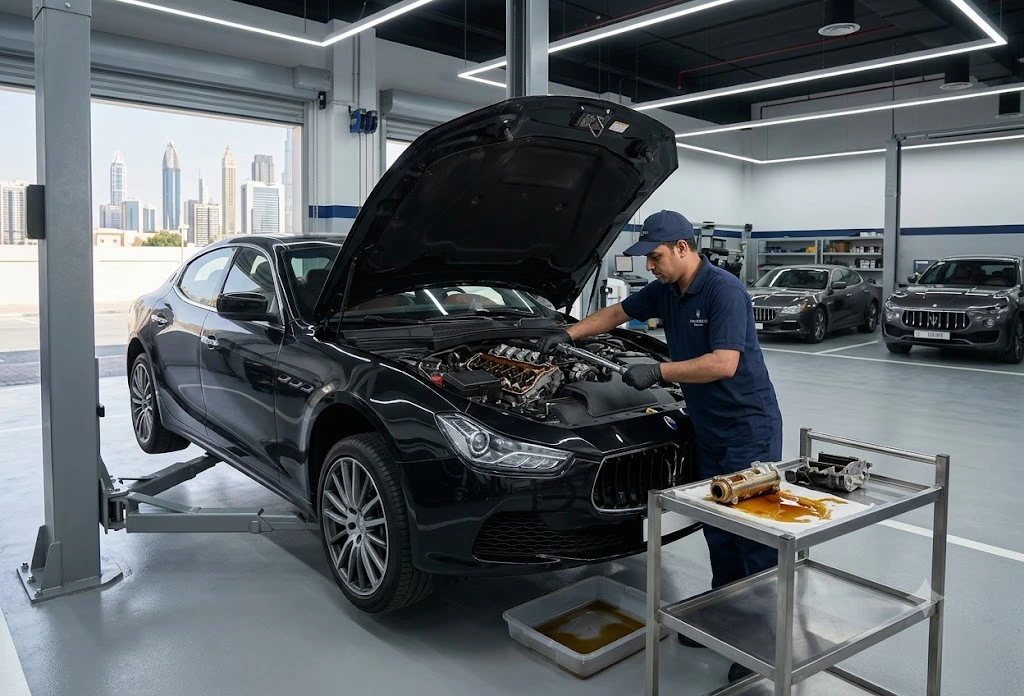
Maserati Oil Leak Repair Dubai: Stop the Drip Before It Costs You an Engine
An oil leak is the most commonly ignored fault on a Maserati, and it is also the one that quietly does the most damage. A few dark spots on the driveway of a villa in Al Barsha or a faint burnt-oil smell in the cabin on the way down Sheikh Zayed Road rarely feels urgent. But in Dubai's climate, a small seep becomes a real leak far faster than it would in Europe, and the oil that escapes almost never lands somewhere harmless. It lands on hot exhaust manifolds, on rubber coolant hoses, on the alternator, on serpentine belts, on catalytic converter shields and on the very engine mounts that keep everything in place.
At Maserati Repairs Dubai we specialise in exactly this kind of work. We are an independent Maserati repair specialist — not an authorized Maserati dealership — and that distinction is the whole reason our customers save money. We use the same diagnostic logic, the same torque specifications, the same sealing procedures and the same quality of parts that the franchised workshops use, but without the overheads that get passed on to you. In practice that means dealer-level repair quality at up to 70% cheaper than authorized dealerships.
Up to 70% cheaper than authorized dealerships. Same diagnostic depth, same sealing standards, same care for your car — a fraction of the invoice. We are independent, which is precisely why we can price this way.
We cover the whole of Dubai, and we make it easy: free pickup and drop-off whether you are in Downtown, Business Bay, Jumeirah, Arabian Ranches, Dubai Marina, JVC, Mirdif, Al Quoz, Dubai Hills, Silicon Oasis, Damac Hills, Palm Jumeirah, Deira or anywhere else across the emirate. You do not need to drive a leaking car through 45°C traffic to reach us. Call +971527914606 or message us on WhatsApp, tell us where the car is, and we will collect it.
This page explains everything an owner needs to know about Maserati oil leaks in Dubai: how to recognise one early, which gaskets and seals actually fail on each model, why the Gulf climate accelerates every one of those failures, how a proper diagnosis is carried out, what the repair involves, and what your parts options are. It is written by the people who do the work, not by a marketing department.
Every non-electric model
Ghibli, Quattroporte, Levante, Grecale, GranTurismo, GranCabrio, MC20 and classic Maseratis — petrol and diesel.
Real diagnosis first
UV dye tracing, degrease-and-drive verification, pressure testing and borescope inspection before a single part is ordered.
Parts, your choice
We source and arrange genuine OEM, quality aftermarket and good used parts — we explain the trade-offs and you decide.
Free Dubai collection
We pick the car up and return it to you at no charge, anywhere in Dubai, once the work is signed off.
How to Spot a Maserati Oil Leak Early
Modern Maseratis are very good at hiding leaks. Full underbody trays, acoustic covers, engine bay shrouding and a hot engine that burns off small amounts of escaping oil all conspire to keep the evidence away from your driveway. That is why most owners in Dubai discover a leak at the smell-and-smoke stage rather than the drip stage. Here is what to watch for, roughly in the order symptoms usually appear.
1. A burnt or acrid smell after driving
This is almost always the first sign, and it is the one owners most often dismiss as "just the car being warm". Oil escaping from a valve cover gasket or a cam cover seal runs down the side of the cylinder head and drips onto the exhaust manifold or the turbocharger housing. There it flashes off, producing a sharp, slightly sweet burnt smell that you notice most strongly when you park up and open the door, or when the car sits idling at a drive-through in Al Quoz. If your Maserati has started to smell "hot" after a normal drive, that is a leak until proven otherwise.
2. Wisps of smoke from the engine bay or under the car
Once enough oil has accumulated on hot metal, you will see thin blue-grey smoke rising from the front of the engine bay after you stop, or drifting out from under the car at traffic lights. It is not usually dramatic. It looks like a heat haze that does not quite behave like a heat haze. In Dubai the surrounding air is already hot enough that this smoke can be faint and easy to miss during the day, so check on a cooler evening or when parked in a shaded basement.
3. Oil spots on the parking bay floor
Because of the underbody trays, oil often travels rearward before it drips, so the puddle position tells you less than you would think. What it does tell you is severity and type. Fresh engine oil is amber to light brown; older engine oil is dark brown to black; transmission and power steering fluid tend to be reddish; and a differential or transfer case leak on a Levante or Grecale is usually thicker and smells noticeably heavier. Place a clean sheet of white card under the car overnight in your building's parking bay and you will get a far clearer picture than staring at a stained concrete floor.
4. The oil level dropping between services
Every Maserati consumes a little oil, particularly the high-revving GranTurismo and MC20 engines. But if you are topping up more than you used to, or the dashboard is asking for oil well before the service interval, something is leaving the engine that should not be. Track it: note the date and the amount added each time. A litre every 3,000 km is a very different conversation from a litre every 800 km, and that data point genuinely helps us narrow down the diagnosis before we even lift the car.
5. Oil residue where it does not belong
Open the bonnet in daylight and look at the outer edges of the cylinder head covers, around the oil filter housing, along the front timing cover, and at the rear of the engine where it meets the gearbox bell housing. Old leaks look like a dark, damp, dust-encrusted film. Fresh leaks look wet and shiny. Because Dubai's air carries fine sand, any oily surface in the engine bay collects a distinctive dark crust — ironically, that sand-and-oil paste is one of our most useful diagnostic clues.
6. Warning lights and gauge behaviour
A low oil level warning is the obvious one. Far more serious is an oil pressure warning, which can appear as a red oil can symbol, a pressure gauge reading lower than usual, or a message on the instrument cluster. An oil pressure warning is not a "drive it to the workshop tomorrow" fault. Stop the car safely, switch off, and call us. Continuing to drive with genuinely low oil pressure can destroy bearings, camshafts and turbochargers within minutes.
7. Rough running, misfires or a check engine light
This one surprises people. On the Ghibli, Quattroporte and Levante V6, oil escaping from a cam cover or spark plug tube seal can seep down into the spark plug wells and sit around the coil packs. The result is a misfire, a stumble under load and a stored fault code that looks like an ignition problem. Replacing coils without addressing the leak is throwing money away — the new coils simply drown in oil too. We check the plug wells as standard on any V6 that arrives with a misfire.
Not sure what you are looking at? Take a photo or a short video of the engine bay, the underside or the spot on your parking bay floor and WhatsApp it to us on +971527914606. We will tell you honestly whether it looks like a seep to monitor or something that needs the car in the workshop this week.
Leaking Oil? Get a Straight Answer Today
Tell us the model, the year and what you have noticed. We will explain the likely cause, the realistic cost range and how long it will take — before your car ever leaves your parking bay. Free pickup anywhere in Dubai.
The Most Common Maserati Oil Leak Points
Maserati engines are not fragile, but they are sealed with a large number of gaskets, O-rings and lip seals, and every one of those is a rubber or elastomer component with a finite life. In the Gulf that life is shorter. Below are the failure points we see week in and week out at our Dubai workshop, described in the order of how often they cross our ramps.
Valve cover gaskets (cam cover gaskets)
This is the single most common oil leak on a Maserati in Dubai, and by a wide margin. The valve cover sits at the top of the cylinder head, sealed by a long rubber gasket that has to stay pliable across an enormous temperature range. Underbonnet temperatures in a Dubai summer routinely exceed anything the gasket sees in a European climate, and after a few years the rubber hardens, shrinks slightly and loses its ability to spring back against the sealing face. Oil then weeps out of the top of the engine and runs down the head.
On the V6 engines fitted to the Ghibli, Quattroporte and Levante there are two covers, one per bank, and it is common for one side to fail well before the other — usually the side closest to the turbocharger, because it runs hotter. On the V8 GranTurismo and GranCabrio the covers are larger and the leak often shows up first as oil pooling in the valley or dripping onto the exhaust. On the twin-turbo V8 in the Quattroporte GTS and Levante Trofeo, the covers are surrounded by tightly packed turbo plumbing, so access is the main cost driver rather than the gasket itself.
A proper valve cover gasket job is not simply "swap the rubber". The cover itself must be checked for warping, the sealing face cleaned back to bare metal without scratching it, the spark plug tube seals renewed at the same time, any PCV or oil separator components inspected, and every bolt torqued in the correct sequence to the correct figure. Over-tightening a magnesium or composite cover distorts it and guarantees a repeat leak. We see plenty of cars that have had this job done twice elsewhere for exactly that reason.
Oil cooler lines, hoses and the oil-to-water heat exchanger
Maseratis run oil coolers because they need them, and Dubai puts those coolers under permanent load. The rubber and braided lines running to and from the cooler flex with engine movement, sit close to hot components, and are exposed to road heat from below. Over time the outer layer perishes, the crimped fittings relax, and the O-rings at the union points harden. The result is a leak that is often mistaken for a valve cover leak, because gravity carries the oil down and rearward from a completely different origin point.
On models with an oil-to-water heat exchanger, a failing internal seal can also allow oil and coolant to mix. If you see a milky, creamy residue on the oil filler cap or an unexplained coolant loss alongside your oil loss, tell us — that changes the diagnostic path significantly and needs urgent attention.
Oil filter housing and its O-rings
The filter housing assembly is sealed with O-rings that get disturbed at every oil service. If a previous workshop reused a hardened O-ring, pinched it during assembly, cross-threaded the cap or over-torqued the housing, you get a slow weep that appears within weeks of a service. This is one of the most frequent "it started leaking right after my last oil change" complaints we hear, and it is usually inexpensive to correct once identified. It is also a good example of why cheap servicing can be expensive: the saved 20 minutes on the previous job costs the owner a diagnosis and a strip-down later.
Front crankshaft seal and timing cover
The front crankshaft seal sits behind the crank pulley and keeps oil inside the timing case. When the seal lip hardens or the pulley develops a groove where the lip rides, oil escapes and is immediately flung outward by the rotating pulley, spraying the front of the engine bay, the belt and the underbody. A telltale sign is oil mist on the inside of the underbody tray and along the auxiliary belt path. This job requires the front of the engine to be accessed properly and, on most models, careful attention to timing components while everything is open — which is exactly why it should be done by someone who knows the engine.
Rear main seal
The rear main seal sits between the engine and the gearbox and is the leak every owner hopes it is not, because access means separating the transmission from the engine. Symptoms are oil dripping from the bell housing area, a wet clutch or torque converter region, and drips that appear well behind the front of the car. It is a labour-intensive job, and it is precisely the kind of repair where the gap between an independent specialist's invoice and a dealership's invoice becomes enormous. This is where owners routinely save many thousands of dirhams with us while getting the same seal and the same standard of work.
Oil pan (sump) gasket and sealant joint
Sumps on these engines are sealed with a gasket or with an anaerobic sealant bead, depending on the model. Leaks here come from three sources: age-hardened sealing material, a sump that has been kissed by a speed bump or a steep ramp entry, or a previous repair where the sealant was applied incorrectly or not given proper cure time. Dubai's abundance of aggressive ramps and speed bumps means low-slung Maseratis take more underbody knocks than most owners realise. We inspect the pan flange for distortion, not just the gasket, because refitting a straight gasket to a bent flange simply fails again.
Turbocharger oil feed and return lines
On turbocharged models — which is most of the modern range — oil is fed to and drained from the turbo through dedicated lines. The feed line runs at full oil pressure and sits in one of the hottest places in the entire car. Its gaskets and banjo seals harden, and when they let go the oil lands directly on the turbo and the exhaust. This is one of the few leaks with a genuine fire risk attached, and it is a leak we treat as urgent. A restricted or coked return line also raises turbo seal pressure and can push oil into the intake, causing blue smoke on start-up and oil in the charge pipes.
Camshaft, variable valve timing and phaser seals
Behind the timing covers sit camshaft seals and the oil circuits that feed the variable valve timing system. Leaks here can be subtle at first — a damp patch that never quite becomes a drip — but they matter because falling oil pressure at the phasers can trigger timing correlation faults and rough running. If your car has both a leak and cam timing fault codes stored, the two are often the same story.
Oil pressure sensor, switch and sender units
These small threaded components are cheap and frequently overlooked. Their seals harden with heat and they begin to weep, sometimes convincingly enough to look like a much bigger leak. We always check them early precisely because finding one of these is the best possible outcome for the customer's wallet.
PCV system, oil separator and crankcase ventilation
This is the leak cause that gets missed most often. The crankcase ventilation system regulates pressure inside the engine. When a PCV valve sticks, a separator diaphragm splits or a ventilation hose collapses, crankcase pressure rises and the engine starts pushing oil out through whichever seal is weakest — typically the valve cover gasket or the rear main seal. Replace only the gasket and the leak comes back, because the real cause was pressure, not the rubber. We test crankcase pressure as part of a full leak diagnosis, and it is one of the clearest differences between a proper diagnosis and a guess.
The lesson from all of this: the place the oil lands is almost never the place the oil left the engine. Any workshop that quotes you a repair over the phone without seeing the car is guessing. We diagnose first, then quote.
Maserati Oil Leak Repair by Model
Every Maserati leaks in its own way. Knowing the typical pattern for your specific model saves diagnostic hours, and diagnostic hours are what you pay for. Here is what we see most often across the non-electric range in Dubai.
Maserati Ghibli
The volume model in Dubai and therefore the one we see most. The twin-turbo V6 typically leaks first at the valve cover gaskets, especially on the hotter bank, followed by oil cooler line unions and the oil filter housing O-rings. Oil in the spark plug wells causing misfires is a classic Ghibli presentation. Diesel Ghiblis sold in the region tend to show turbo oil line and front seal issues instead.
Maserati Quattroporte
Both the V6 and the twin-turbo V8 Quattroporte suffer valve cover and cam cover leaks, but the V8 adds heat-soaked turbo oil feed lines and heat exchanger seals to the list. The car's size means oil can travel a long way before it drips, so a full underbody strip and clean is often needed before the true source is visible.
Maserati Levante
The Levante's height means owners notice drips later, because the oil disperses across a large underbody tray. Common points are valve covers, oil cooler lines, the filter housing and, on higher-mileage cars, front crank seals. On Levantes we also check the transfer case and differential seals, because owners frequently mistake driveline oil for engine oil.
Maserati Grecale
The newest combustion SUV in the range and generally the tightest, but Dubai heat is already producing early gasket seeps and O-ring weeps on cars that live outdoors. On Grecales we pay particular attention to the oil filter housing, cooler unions and turbo oil lines, and we are careful to distinguish a genuine leak from residual assembly oil.
GranTurismo & GranCabrio
The naturally aspirated V8 cars are beloved and they do leak — usually valve covers, front crank seal and sump joint, made more likely by the high oil temperatures these engines reach when driven the way they deserve. On GranCabrio models we take extra care to protect the hood, trim and interior during workshop time.
Maserati MC20
A very different animal, with a mid-mounted twin-turbo V6 packed into a tight bay. Leaks are far less common, but when they occur they are usually turbo oil line seals or cooler unions, and access is everything. We treat MC20 work with the extra caution the carbon tub and bodywork demand, including protective covers and controlled lifting points.
Classic Maseratis
Older Maseratis — the earlier Quattroportes, the Biturbo family, the 3200 GT, 4200 and their contemporaries — leak because their gaskets and seals were designed decades ago and have lived through decades of heat. Here the work is as much about sympathetic restoration as repair: correct sealant, correct torque, correct gasket material, and no shortcuts that damage originality.
Non-electric range only
We service every non-electric Maserati across petrol and diesel drivetrains. If your car has an engine, an oil filter and a sump, we can find and fix its leak — and we can collect it from anywhere in Dubai free of charge to do so.
Why Dubai's Climate Accelerates Maserati Oil Leaks
The same Maserati that seals perfectly for a decade in Northern Europe can develop a weep in three or four years here. This is not a defect in the car; it is physics. Understanding it helps you plan maintenance instead of reacting to failures.
Rubber ages faster in sustained heat
Gaskets, O-rings and lip seals are elastomers, and elastomers age through a process accelerated by temperature. Every sustained increase in operating temperature meaningfully shortens the working life of the material. A Dubai summer means ambient temperatures above 40°C for months, tarmac surface temperatures far higher, and underbonnet temperatures that stay elevated long after the engine is switched off because there is no cool air to soak the heat away. Rubber that has hardened loses its compression set recovery — it can no longer push back against the sealing surface — and that is when a seep begins.
Heat soak after shutdown is brutal here
When you park a Maserati in an open car park in Al Barsha in July, the engine bay temperature actually rises for several minutes after shutdown because the airflow stops but the stored heat does not. This post-shutdown heat soak is one of the harshest conditions any gasket experiences, and Dubai delivers it every single day for half the year. It also explains why so many leaks are first noticed as a smell when you return to a parked car.
Stop-start traffic keeps oil temperatures high
Crawling along Sheikh Zayed Road or Al Khail Road at peak hour gives an engine high load with minimal cooling airflow. Oil temperature climbs, oil thins, and thinner oil finds smaller gaps. A gasket that seals fine at 90°C oil temperature may weep at 120°C. This is why many owners report that their car only leaks in summer, or only after long traffic delays — it is a genuine effect, not their imagination.
Short trips cause moisture and pressure problems
Plenty of Maseratis in Dubai are second or third cars, used for short runs to a mall or a restaurant. Short trips prevent the oil reaching full temperature, allowing moisture and fuel dilution to accumulate. That degrades the oil's ability to protect, and it loads the crankcase ventilation system, which raises internal pressure and pushes on seals. Low mileage does not automatically mean low wear on a car in this climate.
Sand, dust and thermal cycling
Fine airborne dust settles on every surface in the engine bay and works into the interfaces where covers meet heads. Combined with daily expansion and contraction cycles as the car heats and cools, this creates abrasive movement at sealing faces. It also means any oil that escapes immediately becomes a dark paste, which is why an old Maserati leak in Dubai looks so much worse than the same leak elsewhere.
The cooling system and the oil system are linked
A radiator with dust-clogged fins, a tired thermostat, a weak fan or a low coolant level all raise oil temperature indirectly. When we investigate a recurring oil leak, we look at cooling performance too. Fixing a gasket while ignoring a car that runs hotter than it should is how you end up back in a workshop within a year.
Practical takeaway for Dubai owners: inspect for seeps every six months rather than every service, use the correct grade of oil for this climate, keep the cooling system in genuinely good order, and treat a small seep as scheduled maintenance rather than waiting for it to become an emergency. Early repairs are dramatically cheaper than late ones.
Maserati Oil Leak Diagnosis in Dubai: How We Find the Real Source
Anyone can see that a car is leaking oil. Finding exactly where it originates, on an engine packed with covers, trays, shields and hoses, is the skilled part — and it is where money is either saved or wasted. Here is our diagnostic process, step by step.
Step 1: Listen to the owner
We start with questions, because your observations narrow the field faster than any tool. When did you first notice it? Does it drip when parked or only after driving? Has the oil level dropped, and how fast? Was there recent work on the car? Do you smell it more in summer? Is there a warning light or a stored fault code? Five minutes of good questions regularly saves an hour on the ramp.
Step 2: Cold inspection and history reading
We inspect the engine cold, in good light, before anything is disturbed. Old leaks look dry, dark and crusted; active leaks look wet. The pattern of staining tells a story about direction of travel and airflow. We photograph everything at this stage so you can see exactly what we saw. We also read the car's fault memory, because codes for cam timing, oil pressure, misfires or crankcase pressure often point straight at the cause.
Step 3: Degrease, then drive
You cannot trace a leak through years of accumulated oily grime. We clean the relevant areas of the engine and underbody thoroughly, dry them, and then run the car — idling, under load and up to full operating temperature — before re-inspecting. A fresh, clean trail on a clean surface is worth more than any amount of guesswork. In Dubai this step matters more than usual because the sand-and-oil crust hides so much.
Step 4: UV dye tracing
This is the tool that makes the difference on difficult cases. A measured quantity of UV-reactive dye is added to the engine oil, the car is run, and the engine bay and underbody are then examined with an ultraviolet lamp in darkness. The dye glows bright at the exact point the oil is escaping and along the path it has travelled. It distinguishes an active leak from historic residue, it separates two simultaneous leaks from one another, and it settles the common confusion between engine oil, gearbox oil and power steering fluid. If the leak is intermittent, we may ask to keep the car for a longer run or a couple of days of normal use to let the dye do its work.
Step 5: Pressure and vacuum testing
Where appropriate we test crankcase pressure to confirm whether the ventilation system is healthy. Excess crankcase pressure is the hidden cause behind a surprising share of "the gasket keeps failing" cases. On oil cooler circuits and heat exchangers we can pressure test to expose a seal that only fails under running pressure. Smoke testing is used where a leak path needs to be visualised in a tight space.
Step 6: Borescope inspection
A flexible camera lets us look behind the timing cover area, down the back of the engine, into the bell housing region and along turbo plumbing without dismantling the car first. That means fewer speculative strip-downs, less labour on your invoice, and a far more accurate quotation.
Step 7: Written findings and an honest quotation
We report back with photographs and, where useful, video. You get told what is leaking, why it is leaking, how urgent it is, what the repair involves, and what your parts options are. If we find two leaks and only one needs doing now, we say so. If we find that the previous workshop's O-ring is the whole problem and the fix is small, we tell you that too. Nothing is ordered and no labour begins until you approve the work.
Diagnosis is not a formality. The most expensive oil leak repair is the one performed on the wrong component. We would rather spend an extra hour finding the truth than have you pay twice.
The Maserati Oil Leak Repair Itself
Once the source is confirmed, the repair follows a disciplined sequence. These are the details that separate a repair that lasts from one that returns.
Controlled disassembly
Covers, intake components, heat shields and trays come off in a documented order, with fasteners bagged and labelled. On modern Maseratis a valve cover job can involve removing intake plumbing, coil packs, wiring harness supports and turbo pipework, and every one of those connectors and clips is a potential future rattle or vacuum leak if refitted carelessly. We photograph the harness routing before removal so it goes back exactly as it came off.
Sealing surface preparation
This is the step most often rushed. The old gasket and any residual sealant must be removed completely without scoring the aluminium or magnesium sealing face. Aggressive scraping creates channels that will leak no matter how good the new gasket is. Surfaces are cleaned, degreased and dried, and the cover is checked for flatness — a warped cover is replaced or corrected, not simply bolted back on with more sealant in the hope it holds.
Correct gaskets, seals and sealant
We fit the correct gasket profile and the correct sealant chemistry for the joint in question, in the correct quantity. Too much sealant is as damaging as too little: excess squeezes into the engine, breaks off and can block oil pickup screens or galleries. Where the manufacturer specifies a cure time before the engine is filled and run, we observe it. That is one of the reasons we sometimes tell you a job needs an extra day.
Torque sequence and specification
Every cover bolt is torqued to specification, in the specified crossing sequence, with a calibrated wrench. Over-torquing distorts covers and crushes gaskets; under-torquing leaves gaps. Where a fastener is single-use or stretch-type, it is replaced rather than reused. This discipline is a large part of why our repairs do not come back.
Replacing the neighbours while you are in there
When a cover is already off, the marginal cost of renewing the spark plug tube seals, the PCV components, a tired hose or the coil pack boots is small. The cost of doing that job again in six months is not. We will always tell you what is worth doing now and what genuinely is not — and we never pad a job with parts that do not need replacing.
Addressing the cause, not just the symptom
If crankcase pressure caused the gasket to blow out, the ventilation fault is repaired as part of the job. If the leak was caused by a cooling problem letting the engine run hot, that gets flagged. Repairing the symptom alone is the fastest route to a repeat visit, and repeat visits are bad for you and bad for our reputation.
Refill, run, and verify
The engine is refilled with the correct grade and quantity of oil, the car is run to full temperature, and the repair area is inspected again under UV light. Then the car is road tested in real Dubai conditions — including traffic, so it heat-soaks properly — and inspected once more when cool. Only then do we consider the job finished and arrange to return the car to you.
Every completed repair is verified under UV light before the car goes back to you. Then we deliver it — free of charge, anywhere in Dubai.
Why an Independent Maserati Specialist Beats the Dealership
Let us be completely clear about who we are. Maserati Repairs Dubai is an independent Maserati repair specialist. We are not an authorized Maserati dealership and we have no affiliation with one. That independence is not a limitation — it is the entire reason we can deliver dealer-level work at up to 70% cheaper than authorized dealerships.
Where the dealership's price actually goes
A franchised dealership carries costs that have nothing to do with the quality of the repair on your car: prime-location showrooms, large sales and admin teams, brand marketing obligations, customer lounges and fixed manufacturer-set labour rates. Those costs are recovered through the workshop invoice. When you pay a dealership labour rate, a meaningful share of what you pay is buying the building, not the mechanic's hands.
What we cut, and what we never cut
We cut overheads, not standards. We keep a specialist workshop, not a showroom. We keep experienced Maserati technicians and the diagnostic equipment the job requires, and we spend our money on tooling and training rather than on marble floors. What we never cut is diagnostic time, torque discipline, part quality or the final verification of a repair.
Up to 70% cheaper than authorized dealerships, with dealer-level repair quality. The saving comes out of overheads and margin — never out of the workmanship on your Maserati.
The comparison, in plain terms
| What matters to you | Authorized dealership | Maserati Repairs Dubai |
|---|---|---|
| Cost of the same oil leak repair | Fixed high labour rate, full retail parts pricing | Up to 70% less for equivalent work |
| Parts options offered | Genuine only, in practice | Genuine OEM, quality aftermarket or good used — your choice, explained |
| Diagnostic approach | Standardised process, often replace-by-procedure | Trace the actual leak with UV dye and pressure testing before quoting |
| Who you speak to | A service advisor | The people who will actually work on the car |
| Repair of older and classic models | Often limited or discouraged | Welcomed, including Biturbo-era and classic Maseratis |
| Collection and delivery in Dubai | Sometimes chargeable or conditional | Free pickup and drop-off, anywhere in Dubai |
| Flexibility on scope | Package-driven | Fix what needs fixing, tell you honestly what can wait |
Independence means honest advice
We have no sales target, no campaign to push and no obligation to upsell you a package. If your leak turns out to be a twenty-minute O-ring correction, that is what we will tell you and that is what we will charge for. If it turns out to be a rear main seal that will take days, we will tell you that too, with photographs, before you commit to anything. Owners come back to us for years because that honesty is consistent.
One thing to be upfront about: insurance
We do not work with insurance companies. We do not process claims, we do not bill insurers and we do not handle approval paperwork on your behalf. Every job we do is arranged directly with the owner. It keeps our pricing transparent and our timelines short, because nothing waits on a surveyor's approval. If your repair is going through an insurance claim, an insurer-approved facility will be the right route for you. If you are paying directly and you want the work done properly for a fair price, that is exactly what we are here for.
Parts for Your Repair: Genuine OEM, Aftermarket or Used
We can arrange and source every part your repair needs. There is no single right answer for every owner or every car, so we present the options honestly, explain what each one means for durability and cost, and let you decide. This choice is one of the biggest reasons an independent specialist can save you so much money.
Genuine OEM parts
Manufacturer-specified components, identical to what your Maserati left the factory with. Exact fitment, exact material specification, and the safest choice for critical sealing surfaces, newer cars still under warranty considerations, low-mileage collector cars and anything where originality matters to you. This is the highest-cost option, and for some jobs it is the one we will recommend.
Quality aftermarket parts
Many Maserati gaskets, seals, hoses and O-rings are made by the same tier-one suppliers who produce for the manufacturer, then sold under their own brand at a lower price. Where we know a specific aftermarket part performs to the same standard, we will offer it and say so plainly. We will not fit unbranded, unverified parts to a sealing joint just to shave a few dirhams — a failed gasket costs far more in labour than it ever saved in parts.
Good used parts
For certain components — covers, housings, brackets, some hard parts and increasingly scarce items on classic Maseratis — a sound used part is a sensible, economical answer. Every used part we source is inspected before it goes anywhere near your engine. Used parts are ideal for older cars, discontinued items and owners who want to control cost sensibly without compromising the sealing components themselves.
How we advise on parts
Our default position is simple: the actual sealing components — gaskets, lip seals, O-rings, stretch bolts — should always be new and of verified quality, because they are the whole point of the repair and because the labour to fit them dwarfs their cost. Surrounding hard parts are where a used or aftermarket option can genuinely save you money without any compromise. We will always tell you where we would spend and where we would not if it were our own car.
Sourcing and availability in Dubai
We have established supply routes for the full non-electric Maserati range, including older and low-volume models where parts are not sitting on a local shelf. If something needs to be brought in, we tell you the realistic timeline upfront rather than letting your car sit in the workshop while you wonder. For classic Maseratis in particular, sourcing is often the longest part of the job and the part where our network matters most.
You always choose. We quote the options, explain the trade-offs in plain language, and fit what you decide on. No pressure, no hidden substitutions.
Our Step-by-Step Service, From Your Parking Bay and Back
Getting a leaking Maserati repaired in Dubai should not be a logistical project. Here is exactly how it works with us.
You call or WhatsApp
Ring +971527914606 or message us on WhatsApp with your model, year and symptoms. Photos and videos are welcome and genuinely useful. We give you an initial assessment and a realistic idea of what to expect.
We collect the car — free
We arrange a pickup time that suits you and collect the car from home, office, villa parking or a building basement anywhere in Dubai, at no cost. If the leak is serious enough that driving is unwise, this matters — you never have to risk the car on a hot run across the city.
Full leak diagnosis
Cold inspection, fault code reading, degrease-and-drive, UV dye tracing, pressure testing and borescope work as needed, until we know precisely what is leaking and why.
Clear quotation with photos
You receive the findings with images, an explanation in plain language, the parts options priced out, the labour, and the time required. Nothing proceeds without your approval.
Parts sourced to your choice
Genuine OEM, quality aftermarket or good used — we arrange and source whatever you have chosen, and we keep you updated if anything needs to be brought in.
The repair is carried out
Correct disassembly, proper surface preparation, correct gaskets and sealant, calibrated torque sequences, and the underlying cause addressed rather than just the symptom.
Verification and road test
Refill, run to temperature, UV re-inspection, a real-world Dubai road test including traffic, then a final cold inspection. We do not sign off a leak repair we have not seen hold.
We deliver it back — free
Your Maserati is cleaned up and returned to your chosen address anywhere in Dubai at no charge, with the old parts available for you to see and a clear explanation of what was done.
We stay available afterwards
If you notice anything at all after the repair, call us. We would far rather hear from you and check the car than have you wonder. That is how a workshop earns repeat customers in a city this connected.
What Determines the Cost of a Maserati Oil Leak Repair in Dubai
Owners always want a number before the car is seen, and we understand why. But an honest workshop cannot give you a firm price for a leak it has not traced. What we can do is explain exactly what drives the cost, so you can judge any quote you receive — from us or anyone else.
Where the leak is
This is the dominant factor by far, and it is about access, not parts. A leaking oil pressure sensor or a filter housing O-ring is inexpensive because it is quick to reach. A valve cover gasket is a mid-range job whose cost depends on how much has to come off to reach the cover. A front crank seal is more involved. A rear main seal, which requires the transmission to be separated, is the most labour-intensive of the common leaks. The gasket itself might cost a fraction of the labour in every one of these cases.
Which model and engine you have
A V6 Ghibli valve cover is more accessible than a twin-turbo V8 Quattroporte cover buried in turbo plumbing. A mid-engined MC20 requires more disassembly than a Levante for equivalent work. Classic Maseratis can be quicker to access mechanically but slower to source parts for. We price the actual work on the actual car.
How many leaks there really are
It is common to find two or three separate seeps on a car that has been leaking for a long time, particularly when the owner has been topping up rather than investigating. We will prioritise them honestly: what must be fixed now, what should be fixed while everything is already apart, and what can genuinely be monitored.
Your parts choice
Genuine OEM, quality aftermarket or good used parts produce meaningfully different totals. This is one of the clearest places where our independence saves you money, because you actually get the choice.
Collateral damage from delay
This is the cost owners never plan for. Oil that has been dripping onto rubber for months degrades belts, hoses, bushes and engine mounts. Oil in the spark plug wells ruins coil packs. Oil on the alternator shortens its life. A leak repaired early is a gasket job. The same leak repaired two years later can be a gasket job plus a belt, plus hoses, plus coils, plus a mount. Early action is the single biggest saving available to you.
Our promise on pricing: we diagnose, we photograph, we quote in writing with your parts options laid out, and we do not start work until you approve it. No surprises appear on the final invoice. And the whole thing still comes in at up to 70% cheaper than an authorized dealership.
Book Your Free Dubai Pickup Now
Independent Maserati specialists. Dealer-level oil leak repair at up to 70% cheaper than authorized dealerships. Genuine, aftermarket or used parts — your choice. Collection and delivery across Dubai at no charge.
Please note: we do not work with insurance companies. All work is arranged directly with the owner.
Should You Keep Driving a Maserati That Is Leaking Oil?
The honest answer depends entirely on the severity and location of the leak — but the risks are real enough that no leak should be ignored indefinitely, and in Dubai's heat the margin for error is smaller than owners expect.
The engine damage risk
Oil is what keeps bearings, camshafts, chains and turbochargers alive. A leak that takes the level below the safe range starves those components. Turbochargers are especially vulnerable because their bearings spin at extremely high speed and rely on constant clean oil flow. Damage of this kind happens quickly and it is not repairable by topping up afterwards.
The fire risk
Oil landing on a hot exhaust manifold, turbocharger or catalytic converter can ignite. This is not a theoretical risk in a city where ambient temperature alone is above 45°C in summer. Any leak that is depositing oil onto exhaust components should be treated as urgent, and a leak that is visibly producing smoke should mean the car is not driven until it has been inspected.
The collateral damage risk
Oil attacks rubber. Belts, coolant hoses, vacuum lines, suspension bushes and engine mounts all soften and fail early when soaked. A cheap gasket left alone becomes an expensive list of secondary repairs, all of which carry their own labour.
The safety and roadworthiness risk
Oil dripping onto a serpentine belt can cause it to slip or shed, taking your alternator, water pump and power steering assist with it — potentially at speed on Sheikh Zayed Road. Oil on the road surface behind you is also a hazard to other vehicles, and a leaking car is unlikely to pass inspection.
So what should you actually do?
- Minor seep, no smoke, stable oil level: normal driving is usually acceptable in the short term, but check the level weekly and book the repair rather than letting it run through the summer.
- Visible drips, oil level falling noticeably: minimise driving, check the level before every trip, and get the car in quickly. Let us collect it.
- Smoke, strong burning smell, or oil on the exhaust: stop driving it. Call us and we will pick it up.
- Any oil pressure warning light: pull over safely, switch the engine off immediately, and call +971527914606. Do not attempt to reach the workshop under your own power.
This is exactly why free pickup exists. You never have to gamble on whether the car will make it across Dubai. Tell us where it is and we will come to it.
Preventing the Next Oil Leak
You cannot stop rubber ageing, but you can slow it down considerably, and you can catch problems while they are still cheap. These are the habits that keep Maseratis in Dubai dry.
Service on time, with the right oil
Use the correct specification and viscosity for your engine and for this climate, and change it at sensible intervals. Old oil loses its additive protection and its ability to keep seals conditioned. Extending intervals to save money is a false economy in a region this hot, particularly on turbocharged engines where oil takes a serious thermal beating.
Insist on new O-rings at every oil service
Filter housing O-rings are cheap and are meant to be replaced, not reused. A large share of post-service leaks come from this single shortcut. Ask your workshop directly whether they replace them.
Keep the cooling system genuinely healthy
Clean radiator and cooler fins, correct coolant level and condition, a functioning thermostat and working fans keep oil temperature where it belongs. Lower oil temperature means longer gasket life. Dust build-up in radiator fins is a Dubai-specific issue worth checking annually.
Look after the crankcase ventilation system
A healthy PCV system prevents pressure building inside the engine and pushing oil past seals. Have it checked periodically, especially on higher-mileage turbocharged cars.
Drive the car properly, at least sometimes
Maseratis dislike being used only for short, cool, low-load journeys. A regular drive that brings the oil fully up to temperature burns off moisture and fuel dilution and keeps seals conditioned. This is one of the more enjoyable pieces of maintenance advice we get to give.
Park with a little thought
Shade and basement parking reduce heat soak dramatically compared with an open lot in July. Over years, that difference genuinely shows up in gasket life, paint condition and interior trim.
Inspect twice a year, and act on what you see
Ten minutes with the bonnet open and a torch, twice a year, catches most leaks while they are seeps. A seep is a routine repair. A leak that has been ignored for two summers is a project. If you would like us to carry out an inspection, we will collect the car free of charge, look it over properly and tell you honestly what we find.
We Also Handle Denting, Painting, Accident Repair and Polishing
Oil leak repair is our specialty on this page, but your Maserati is one car and it deserves one workshop that can look after all of it. While your car is with us for a leak repair, we can address bodywork and finish at the same time — which saves you a second collection, a second delivery and a second stretch of time without your car.
Denting and dent removal
Parking dings from mall car parks, trolley marks, door edges and small impact dents corrected properly. Where the paint is unbroken, paintless dent removal preserves your original factory finish, which is always the ideal outcome on a car like this.
Painting and refinishing
Colour-matched refinishing for scuffs, scratches, kerbed panels and full panel respray work. Maserati colours — particularly the metallics and tri-coats — demand careful matching and correct blending into adjacent panels. Dubai sun is unforgiving of a poor match, so we do not rush this.
Accident repair
Structural and cosmetic accident damage assessed and repaired to a proper standard, with correct panel alignment, gap consistency and finish. Please note that we do not work with insurance companies — accident repair with us is arranged and paid directly by the owner, which keeps timelines short and communication simple.
Polishing and paint correction
Machine polishing and paint correction to remove swirl marks, wash scratches and the dulling that Dubai's sun, sand and hard water inflict on dark paint in particular. The transformation on a black or blue Maserati is genuinely dramatic.
And of course, the same free pickup and drop-off across Dubai applies to bodywork and detailing jobs. Mention it when you call +971527914606 and we will quote the mechanical and cosmetic work together.
Maserati Oil Leak Repair Dubai: Frequently Asked Questions
How do I know if my Maserati is leaking oil?
The earliest sign is usually a burnt, acrid smell after driving, caused by oil dripping onto hot exhaust components. Next come faint wisps of blue-grey smoke from the engine bay when you park, dark spots on your parking bay floor, and an oil level that drops between services. Look for wet or dark crusted residue around the valve covers, oil filter housing and the rear of the engine. On V6 models, oil in the spark plug wells can cause misfires and a check engine light. If you are unsure, WhatsApp us photos on +971527914606 and we will tell you honestly what it looks like.
How much does oil leak repair cost in Dubai compared to the authorized dealership?
Our pricing runs up to 70% cheaper than authorized dealerships for equivalent work, because we are an independent specialist without showroom overheads and fixed manufacturer labour rates. The actual figure depends on where the leak is, since access drives labour: a filter housing O-ring is inexpensive, a valve cover gasket is mid-range, and a rear main seal is the most labour-intensive. Your parts choice also matters, because we offer genuine OEM, quality aftermarket and good used options. We diagnose the car properly, send you photographs and a written quote, and never begin work without your approval.
How long does oil leak repair take at your workshop?
Diagnosis typically takes a few hours, though UV dye tracing on an intermittent leak sometimes needs the car overnight or for a couple of days of running. Simple repairs such as an oil pressure sensor or filter housing O-ring can often be completed the same day. Valve cover gaskets usually take one to two days. Front crank seals, oil cooler line work and turbo oil line jobs typically take two to three days. A rear main seal, which requires the transmission to be separated, takes longer. Parts sourcing can add time on rarer and classic models, and we always tell you the realistic timeline upfront.
Which Maserati models do you offer oil leak repair for?
We service every non-electric Maserati: Ghibli, Quattroporte, Levante, Grecale, GranTurismo, GranCabrio, MC20 and classic Maseratis including the earlier Quattroportes, the Biturbo family, the 3200 GT and the 4200. That covers V6 and V8 petrol engines, turbocharged and naturally aspirated, as well as the diesel variants sold in this region. Older cars are genuinely welcome rather than tolerated — classic Maseratis are some of our most rewarding work, and we have the parts-sourcing network to support them. Whatever the model, we collect it free of charge from anywhere in Dubai.
Do you use genuine, aftermarket or used parts for oil leak repair?
All three — we can arrange and source whichever you prefer, and we explain the trade-offs clearly before you decide. Genuine OEM parts give exact factory specification and are our recommendation for newer cars and critical applications. Quality aftermarket parts, often from the same tier-one manufacturers, can deliver equivalent performance for less. Good used parts are a sensible economical route for housings, covers, brackets and hard-to-find classic components, and every used part is inspected before fitting. Our own advice is consistent: sealing components like gaskets, lip seals and stretch bolts should always be new and verified, because labour dwarfs their cost.
Is it safe to drive my Maserati with an oil leak?
It depends on severity. A minor seep with a stable oil level is usually acceptable short-term, but should be booked in rather than left through a Dubai summer. Visible drips with a falling oil level mean you should minimise driving and check the level before every trip. If you see smoke, smell strong burning, or find oil on the exhaust, stop driving — oil on hot exhaust components is a genuine fire risk at these ambient temperatures. If an oil pressure warning appears, pull over safely, switch off immediately and call us, because low oil pressure destroys bearings and turbochargers within minutes. We will collect the car.
What are the most common Maserati oil leak points?
Valve cover gaskets are by far the most common, especially in Dubai's heat, which hardens the rubber and destroys its ability to seal. Next come oil cooler lines and their union O-rings, oil filter housing seals, the front crankshaft seal behind the pulley, the oil pan gasket or sealant joint, and turbocharger oil feed and return line seals. Rear main seals leak less often but cost the most to fix. We also always check crankcase ventilation, because excess pressure from a failed PCV system blows out gaskets repeatedly — fix only the gasket and the leak simply returns.
Are you an authorized Maserati dealership?
No. Maserati Repairs Dubai is an independent Maserati repair specialist with no affiliation to any authorized dealership, and we are always upfront about that. Our independence is exactly why we can charge up to 70% less while delivering dealer-level repair quality: we carry none of the showroom, marketing and admin overheads that inflate a franchised workshop's labour rate. We invest instead in Maserati-experienced technicians, proper diagnostic equipment and correct tooling. It also means we can offer you genuine, aftermarket or used parts rather than a single option, and give advice with no sales target behind it.
Do you offer free pickup and drop-off anywhere in Dubai?
Yes, completely free across the whole of Dubai, both ways. We collect from villas, apartment building basements, offices and business parks — Downtown, Business Bay, Jumeirah, Dubai Marina, JBR, Palm Jumeirah, Arabian Ranches, Dubai Hills, JVC, Mirdif, Deira, Al Quoz, Silicon Oasis, Damac Hills and everywhere in between. This matters particularly with oil leaks, because you should not be driving a leaking Maserati across the city in 45°C heat. Once the repair is complete and verified, we clean the car up and deliver it back to the address of your choice at no charge.
Do you work with insurance companies?
No, we do not work with insurance companies. We do not process claims, bill insurers or handle claim approval paperwork, and this applies to all our services including accident repair, denting and painting. Every job is arranged and settled directly with the vehicle owner. We are upfront about this because it saves everyone time: it keeps our pricing transparent and our turnaround fast, since nothing waits on a surveyor's approval. If your repair must go through an insurance claim, an insurer-approved facility is the right route. If you are paying directly, we will look after your Maserati properly for far less.
Get Your Maserati Oil Leak Fixed Properly — For Far Less
Independent Maserati specialists covering all of Dubai. Proper UV dye diagnosis, correct gaskets and seals, calibrated torque, and a repair verified before your car is returned. Dealer-level quality at up to 70% cheaper than authorized dealerships, with genuine OEM, aftermarket or used parts sourced to your choice — and free pickup and drop-off anywhere in the emirate.
Maserati Repairs Dubai · Maseratirepairsdubai.ae · Dubai, UAE · Ghibli, Quattroporte, Levante, Grecale, GranTurismo, GranCabrio, MC20 and classic Maseratis. Independent specialist, not an authorized dealership. We do not work with insurance companies.