
Maserati Limp Mode: Why It Happens and How to Fix It
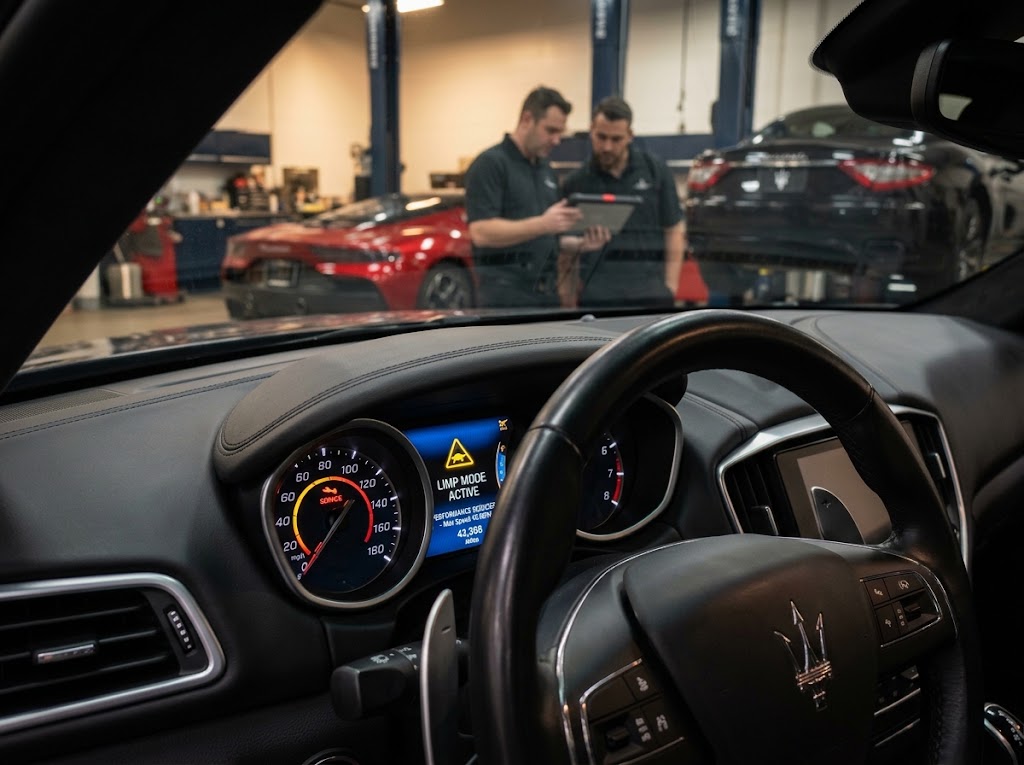
You press the throttle to merge and the car barely responds: the revs won't climb, the gearbox holds one gear and an amber warning appears. That is Maserati limp mode, and this guide explains, for Ghibli, Levante and Quattroporte owners in Dubai, what triggers it and how it is fixed.
Quick answer
Maserati limp mode is a fail-safe that cuts power, caps revs and often holds one gear when the engine or gearbox computer detects a potentially damaging fault. Common triggers are transmission faults, boost leaks, throttle or pedal sensor errors, low battery voltage, overheating and wiring damage. Drive gently to safety, then have the stored fault codes read.
Key takeaways
- Maserati limp mode is a symptom, not a diagnosis: the stored fault codes point to the system that caused it.
- Low battery voltage is an often-overlooked trigger, so test the battery before condemning the gearbox.
- Restarting may restore full power, but the stored fault and its cause remain until repaired.
- Drive in limp mode only to the nearest safe stop, and keep off fast roads like Sheikh Zayed Road.
- Dubai heat, dust and stop-start traffic accelerate the battery, cooling and gearbox-fluid wear behind many limp mode cases.
What is Maserati limp mode, and why does your car use it?
Limp mode is a self-protection state built into your Maserati's engine and gearbox software. When a module detects a potentially damaging reading, it restricts the car so you can still move it, gently.
The control units constantly compare sensor readings with expected values. If boost overshoots, the pedal's two signals disagree or gearbox fluid overheats, the software cuts torque, caps revs, holds one gear and blocks Sport mode, because runaway boost or heat can wreck a turbo quickly. The real problem is whatever set it off.
What are the signs your Maserati is in limp mode?
The giveaway is a sudden loss of power with a warning on the cluster, often while the gearbox refuses to shift normally. Watch for:
- Acceleration feels flat and the revs stop climbing early.
- The gearbox holds one gear, shifts harshly or ignores the paddles.
- Sport mode won't engage and start-stop may switch off.
- An amber engine light, gearbox message or MSP stability warning appears.
Owners usually tell us they went to overtake and the car simply didn't respond. Many search "Maserati reduced power" before they've heard of limp mode.
Don't confuse it with summer sluggishness. Any Maserati feels slightly softer on a 46°C afternoon, but true limp mode brings a warning light and a held gear.
What causes Maserati limp mode?
Most cases trace back to the gearbox, boost system, throttle and pedal sensors, battery voltage, cooling or wiring. The fault code points to which.
Transmission faults
Maserati transmission limp mode is the most noticeable version: the ZF eight-speed automatic locks into a safe gear. Old or low fluid, a sticking mechatronic solenoid, a failing speed sensor or a leaking connector seal can trigger it.
Boost and turbo faults
The engine computer compares requested boost with actual boost. A split charge pipe, loose intercooler clamp or sticking wastegate actuator opens a gap and power is cut; a failed turbo is rarely our first suspect.
Throttle body and pedal sensors
Your throttle is electronic, and the pedal sends two signals that must agree. A carbon-coated throttle body, worn pedal sensor or corroded plug breaks that agreement, so power is limited.
Low battery voltage
Control modules dislike low voltage. A tired battery dipping during cranking can make them lose contact with each other, leaving unrelated codes and often a gearbox stuck in one gear.
Overheating
When coolant or gearbox fluid runs too hot, power is trimmed to bring temperatures down. Weak fans, a sticking thermostat, a tired water pump, a leak or a dust-caked radiator are the usual causes.
Wiring and connectors
Harnesses baked near the turbos, chafed looms and pins corroded by coastal humidity cause the faults that come and go. They are easy to misdiagnose: a good sensor gets replaced and the warning returns.
| Cause | Symptoms alongside limp mode | Fix |
|---|---|---|
| Transmission fault | Harsh shifts, stuck in one gear | Code scan, fluid check at the correct temperature, solenoid or sensor repair |
| Boost leak or turbo fault | Hissing under load, slow pull | Smoke test, replace hoses or clamps, test wastegate actuators |
| Throttle or pedal sensor | Dead pedal, hunting idle | Clean or replace throttle body, test pedal signals, relearn |
| Low battery voltage | Several unrelated warnings, slow cranking | Test battery, alternator and earths; replace if weak |
| Overheating | Rising temperature gauge, roaring fans, warmer air-con | Check coolant, fans, thermostat and pump; clean radiator |
| Wiring or connector fault | Comes and goes, often after a wash or rain | Trace harness, clean or repin connectors |
The Dubai factor
Summer heat links many of the cases we see here. A 4pm crawl along Sheikh Zayed Road runs the engine bay far hotter than the 45°C outside, and months of that harden hoses, age batteries and cook gearbox fluid.