
Maserati Ghibli Problems: The Most Common Faults Dubai Owners Face
A Ghibli that starts perfectly in January can greet you with a dead battery and five warning lights in July, and that pattern sits behind many of the Maserati Ghibli problems we fix in Dubai. This guide is for owners and buyers who want to know which faults are normal wear, which are costly, and which are simply the climate talking.
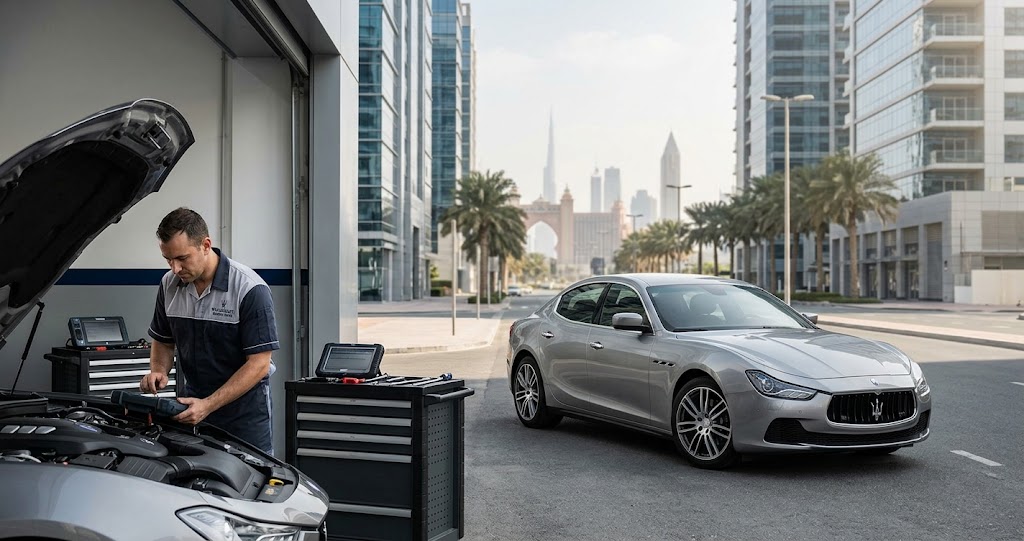
Quick answer
The most common Maserati Ghibli problems are battery drain and electrical warning lights, oil leaks and misfires on the 3.0 V6 twin-turbo, jerky ZF 8-speed shifts, worn front suspension bushes, sticky interior trim and weak air conditioning. In Dubai, heat and short trips make most of them appear sooner, but nearly all are fixable with accurate diagnosis and routine care.
Key takeaways
- A weak battery or failed battery sensor is the most common trigger of random Ghibli warning lights, so it should be tested before any control module is replaced.
- The Ferrari-built 3.0 V6 twin-turbo is tough at its core, but gaskets, ignition coils and intake carbon need attention as the kilometres rise.
- Most Maserati Ghibli transmission problems trace back to old fluid, low voltage or outdated software rather than a failed gearbox.
- Dubai heat shortens the life of batteries, seals, cooling parts and cabin trim, so UAE owners should service more often than the factory minimum.
Is the Maserati Ghibli a reliable car?
Yes, if it is maintained on time, and noticeably less so if it is not. Early 2014–2016 cars carry the most known faults, 2017–2020 cars are better sorted, and 2021-onward cars are the most refined.
Maserati Ghibli reliability suffers more from its surroundings than from its core hardware. The ZF gearbox and Ferrari-assembled V6 are proven designs; the weak points are voltage-sensitive electronics, rubber and plastic parts that age quickly in heat, and service schedules that get stretched. A Ghibli arriving with ten complaints usually has one or two root causes, not ten separate failures.
Maserati Ghibli common problems at a glance
Here is how the Maserati Ghibli problems we see most often tend to present, and what they usually mean.
| Problem | Symptoms | Likely cause | Typical fix |
|---|---|---|---|
| Battery drain | Won't start after a few days parked; keyless entry fails | Ageing battery, faulty battery sensor or a module staying awake | Load test, sensor check, parasitic drain trace |
| Random warning lights | Several warnings at once, sometimes clearing on restart | Low voltage, poor earth connections, wheel speed sensor | Voltage and fault-code check before any parts |
| Oil leaks | Hot-oil smell after driving, drips under the car | Hardened valve cover or oil cooler gaskets | New gaskets, degrease, recheck after a heat cycle |
| Misfire | Shaking at idle, engine light, lost power | Worn spark plugs or a failing ignition coil | Confirm the cylinder, replace plugs and faulty coil |
| Carbon build-up | Rough idle, hesitation, higher fuel use | Direct injection deposits on intake valves | Intake valve cleaning |
| Harsh shifts | Jolts in traffic, slow Drive or Reverse engagement | Aged fluid, mechatronic wear, old software | Fluid service, adaptation reset, software check |
| Gear selector faults | Gear warnings, Park not engaged when expected | Monostable lever switch or wiring fault | Lever and module diagnosis, updates applied |
| Front suspension knock | Clunk over bumps, vague steering | Worn control arm bushes and ball joints | Replace arms or bushes, four-wheel alignment |
| Infotainment freezing | Blank screen, reboots, lost Bluetooth or camera | Software faults, heat, low voltage | Reflash, reset or head unit repair |
| Weak AC | Warm air at idle, fans roaring | Clogged condenser, refrigerant leak, fan or compressor fault | Leak test, condenser clean, repair and recharge |
What causes Maserati Ghibli electrical problems?
Most Maserati Ghibli electrical problems start with the battery. The car's control modules are sensitive to voltage, so a tired battery creates warning lights and sensor errors that look like much bigger faults.
Battery drain and the battery sensor
The battery lives in the boot, with an intelligent sensor on the negative terminal that reports its condition to the car. When that sensor fails or the battery ages, charging goes wrong and the car can be flat after a few days in a basement car park. Dashcams and trackers wired to permanent power are another frequent drain.
Why several warning lights appear at once
A familiar story: the owner returns from a weekend away and sees ESP, tyre pressure, parking sensor and engine warnings together. At Maserati Repairs Dubai we load-test the battery and check earth points before touching a sensor, because a genuine sensor fault normally leaves one consistent code, not a full dashboard. When a sensor really has failed, wheel speed and tyre pressure sensors are the usual suspects.
The Dubai factor
Ghibli batteries rarely die in the cooler months. They fail in summer, when boot temperatures climb well beyond the 45°C outside air and the car sits for weeks while its owner travels. For absences longer than two weeks, a quality battery maintainer and a covered parking spot are cheap protection.
What engine problems affect the 3.0 V6 twin-turbo?
Oil leaks, ignition coil failures, intake carbon build-up and boost-related faults are the main ones. The engine itself is strong, and nearly all of these give warning signs well before serious damage occurs.
Oil leaks
Valve cover and oil cooler gaskets harden after years of heat cycles. The first clue is often a hot-oil smell at the lights on Sheikh Zayed Road as oil seeps onto the exhaust. Ignored, the leak soaks nearby wiring and hoses.
Ignition coils and spark plugs
A misfire shows as shaking at idle and an engine warning light. Heat kills coils as much as mileage does. We move a suspect coil to another cylinder and check that the fault follows it, rather than fitting a full set when only one is weak.
Turbos and carbon build-up
Direct injection means fuel no longer washes the intake valves, so carbon collects, especially on cars used mainly for short mall trips. Owners often tell us the car feels flat at higher revs. Before blaming the turbos, we smoke-test for split boost hoses and check the wastegates, which are the more usual culprits.
Warning
A flashing engine light signals an active misfire. Driving on can overheat the catalytic converters with unburnt fuel, turning a coil replacement into a far bigger repair. Stop when it is safe and have the car recovered or inspected.
Is the ZF 8-speed gearbox a weak point on the Ghibli?
Rarely. The ZF 8-speed automatic is robust, and most shifting complaints come from aged fluid, low battery voltage or adaptation values that need resetting.
Typical symptoms are a jolt when rolling to a stop, a pause before Drive or Reverse engages, or a thump on downshifts in heavy traffic. The fluid is often described as lifetime, but Dubai's stop-start heat wears it out long before the car is finished. A fluid and filter service to the correct specification plus an adaptation reset cures many cars; if not, the mechatronic unit can be repaired, a far smaller job than a gearbox replacement.
The gear selector
Earlier Ghibli models use a monostable lever that springs back to the centre after each selection, and some drivers assume Park is engaged when it is not. Worn switches or wiring in the lever can also trigger gear warnings or no-start faults. Always confirm the P indicator before stepping out, and ask whether any manufacturer campaigns are outstanding on your VIN.
What wears out in the suspension, steering and brakes?
Front control arm bushes, ball joints, brake pads and discs wear fastest. The Ghibli is a heavy car, and Dubai's speed bumps and steep car-park ramps load the front end constantly.
A clunk over bumps or a knock when turning into a parking bay usually means worn lower arm bushes. Cars with Skyhook adaptive dampers can also develop leaking shock absorbers, felt as a floaty ride. We inspect both sides together, because replacing one arm while its partner is worn only moves the noise.
Earlier cars use hydraulic power steering, so check for seepage and a whine at full lock. Wear on the inner tyre edges points to alignment drift. Pads and discs are sized for stopping power rather than longevity, and discs are usually replaced with the pads instead of being skimmed.
Why do the touchscreen and interior trim fail in hot climates?
Software and heat are the two causes. Screens freeze or reboot, and soft-touch coatings on switches and trim turn sticky after years of strong sun.
Pre-2017 cars run an older 8.4-inch system prone to freezing and dropped Bluetooth. The 2017 update added Apple CarPlay and Android Auto, and the 2021 facelift brought a 10.1-inch screen. A software reflash fixes many complaints, and a failing head unit can often be repaired rather than replaced.
The tacky finish on window switches, console panels and door pulls is UV-damaged coating, and household cleaners make it worse. Refinishing or replacing those parts restores them properly. Dashboard leather can also shrink and lift at the edges on cars parked in open sun.
Why do Ghibli cooling and AC systems struggle in Dubai summers?
They run close to their limit. Engine coolant, turbo intercooling and air conditioning all shed heat through the front radiators, and 45°C+ air laden with sand and dust leaves little margin for a weak part.
The classic AC complaint is warm air at idle that turns cold once the car is moving. That points to airflow, usually a condenser clogged with sand or a cooling fan not reaching full speed, rather than refrigerant. On the engine side, plastic coolant pipes, the expansion tank and the thermostat housing grow brittle, so a falling coolant level or a sweet smell needs attention before summer arrives.
The Dubai factor
Crawling along Sheikh Zayed Road at 3 pm in August stresses a Ghibli's cooling more than a fast motorway run, because almost no air passes through the radiators. If the gauge climbs or the AC weakens in slow traffic but recovers at speed, have the fans and condenser checked before the next heatwave.
Which years have the most Maserati Ghibli problems?
The 2014–2016 cars have the most known faults, 2017–2020 models are better sorted, and 2021-onward cars are the most refined. Condition and service history still matter more than the model year.
When buyers ask about Maserati Ghibli issues by year, we point out that a well-kept 2015 can easily outlast a neglected 2019.
| Model years | What changed | Faults to check | Buying tip |
|---|---|---|---|
| 2014–2016 | Launch model, older 8.4-inch infotainment, hydraulic steering | Battery sensor, screen freezing, selector complaints, age-related oil leaks | Ask for records of battery, coil and fluid work |
| 2017–2020 | Updated infotainment with CarPlay and Android Auto, driver-assistance features | Camera and radar sensor faults, suspension bushes, carbon build-up | Check software updates and the front suspension |
| 2021 onward | Facelift with 10.1-inch screen, new lights, 2.0 four-cylinder and Trofeo V8 versions | Mostly age-related wear, software glitches, AC and trim in heat | Best starting point, but still inspect before buying |
Which maintenance habits prevent most Ghibli problems?
Shorter service intervals, a healthy battery and regular fluid changes prevent the majority of Maserati Ghibli problems. Dubai conditions justify servicing more often than the factory schedule suggests.
- Shorten oil changes. In Dubai use, change oil and filter roughly every 10,000 km or six months, whichever comes first, with oil that meets Maserati's specification.
- Test the battery before and after summer. A load test catches a weak battery before it causes electrical confusion.
- Service the gearbox fluid. Treat the ZF fluid as serviceable, not lifetime, and reset adaptations after changing it.
- Give it a proper drive weekly. Twenty minutes at a steady speed charges the battery and helps burn off deposits that short trips leave behind.
- Clean the condenser each spring. Removing sand and debris from the front radiators keeps AC and engine cooling efficient.
- Protect the cabin. A windscreen sunshade and covered parking slow damage to trim, leather and screens.
Pro tip from our technicians
Tell us exactly when a symptom appears, such as 'only after the car sits in the sun' or 'only after a car wash'. Details like that can shrink a diagnosis from hours to minutes.
Dealer or independent specialist: who should repair your Ghibli?
While the car is under warranty, the authorised dealer is the logical choice. After that, an experienced independent specialist can match dealer-level diagnosis at a considerably lower cost.
Maserati Repairs Dubai is an independent workshop, not an authorised Maserati dealer. Almost every one of the Maserati Ghibli problems in this guide can be handled outside the dealer network. When comparing options for Ghibli repair, Dubai owners should ask whether the workshop uses Maserati diagnostic software, explains the fault before quoting, and shows the old parts afterwards.
Root cause first
We read the fault history and test voltage before quoting, so you pay only for the repair the car needs.
You choose the parts
Genuine OEM, premium aftermarket or inspected used parts, with the trade-offs explained so the decision is yours.
Collection across Dubai
We pick the car up and bring it back at no charge, so the repair does not cost you a working day.
A real quote, not a guess
Price depends on the fault, labour time and parts route. Send your symptoms on WhatsApp for an exact figure.
Frequently asked questions
What is the most common problem with the Maserati Ghibli?
Battery-related electrical faults are the most common problem with the Maserati Ghibli. A weak battery or failing battery sensor can cause starting trouble, warning lights and sensor errors all at once. Testing the battery and charging system first often solves what looks like a serious electronic fault.
Which Maserati Ghibli year is the most reliable?
The 2021-onward Ghibli is generally the most reliable, thanks to updated electronics and infotainment from the final facelift. Among older cars, 2017–2020 models are a sensible middle ground. In practice, service history and a pre-purchase inspection tell you more about a specific car than its model year.
Why does my Ghibli battery keep going flat?
A Ghibli battery usually goes flat because the battery is ageing, the battery sensor has failed, or something keeps drawing power after the car is locked, such as a dashcam or tracker. Long spells parked in Dubai heat speed this up, so start with a load test and a parasitic drain check.
Is the Maserati Ghibli expensive to repair in Dubai?
It can be at a main dealer, but the cost depends heavily on the fault. Labour time, how hard the part is to reach and the parts route you choose all shape the bill. An independent specialist can often do the same work for up to 70% less, so compare quotes.
How often should a Ghibli be serviced in the UAE?
Service a Ghibli in the UAE at least once a year, with oil and filter changes about every 10,000 km or six months, whichever comes first. Heat, dust and short stop-start trips age oil faster than the factory schedule assumes, and batteries and AC benefit from pre-summer checks.
Does Dubai heat damage the Maserati Ghibli?
Yes, Dubai heat speeds up wear on several Ghibli components. Batteries, rubber seals, coolant pipes, AC parts and soft-touch interior trim all age faster under intense sun and 45°C+ temperatures. Covered parking, a windscreen sunshade and shorter service intervals reduce the effect considerably.
Can a non-dealer garage repair a Maserati Ghibli properly?
Yes, an independent specialist with Maserati diagnostic equipment and experienced technicians can repair a Ghibli to dealer standard. Model-specific knowledge matters more than a dealer badge. Maserati Repairs Dubai works on Ghibli, Levante, Quattroporte and other Maserati models daily as an independent specialist, not an authorised dealer.
How long does a Ghibli last with proper maintenance?
A Ghibli serviced on time can stay dependable for many years and high mileage. The V6 engine and ZF gearbox are durable when oil, fluids and cooling are looked after. Cars that fail early are usually victims of skipped services, ignored leaks and neglected batteries rather than weak engineering.