
Maserati Engine Problems: V6 Twin-Turbo and V8 Issues Explained
A cold-start rattle in the villa garage, a flashing engine light on Sheikh Zayed Road or a blue haze in the mirror: most Maserati engine problems give clear warnings before they become expensive. This guide is for Ghibli, Levante, Quattroporte, GranTurismo, Grecale and MC20 owners who want to know what each fault means and how it gets fixed.
Quick answer
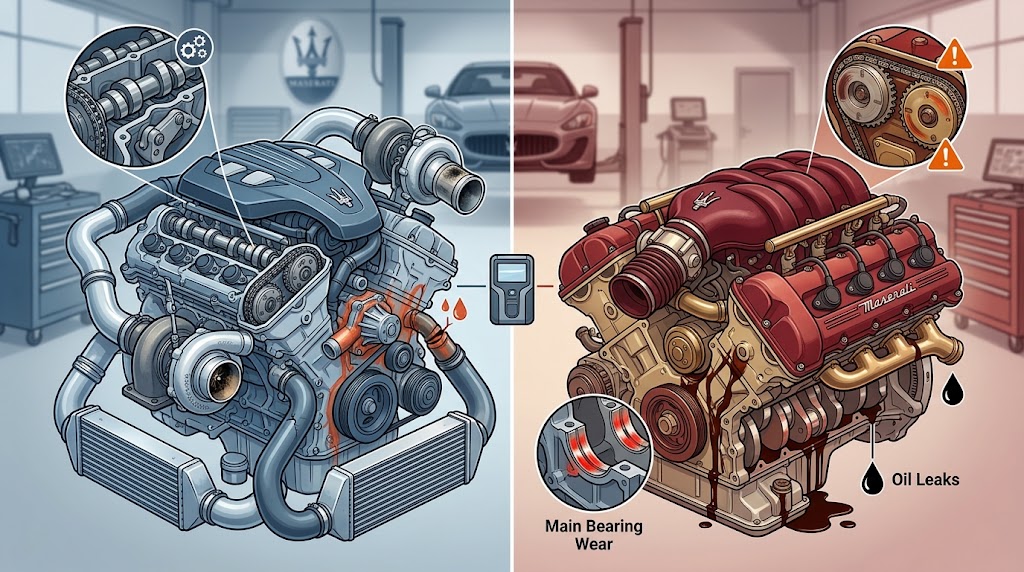
The most common Maserati engine problems are ignition coil and spark plug misfires, oil leaks from cam covers and turbo lines, turbo wastegate rattle and boost leaks, carbon build-up on direct-injection V6 intake valves, cam variator wear on older 4.2/4.7 V8s, and cooling-system failures that Dubai heat accelerates. Most are repairable when caught early with proper diagnostics.
Key takeaways
- Worn plugs and tired ignition coils are among the most frequent misfire causes on the 3.0 V6 Ghibli, Levante and Quattroporte.
- A flashing engine warning light signals an active misfire, and continuing to drive hard can overheat the catalytic converters.
- Older 4.2 and 4.7 V8 engines often develop cam variator wear, heard as a short clatter on cold start before oil pressure builds.
- Dubai heat and stop-start traffic age cooling parts, coils and engine oil faster, so Maserati engine problems tend to surface sooner here than in milder climates.
Which engines does Maserati use?
Maserati's recent petrol engines fall into five families: the 3.0 V6 twin-turbo, 3.8 V8 twin-turbo, naturally aspirated 4.2 and 4.7 V8s, the Nettuno V6 and a 2.0 four-cylinder mild hybrid. Ferrari built the twin-turbo V6 and V8, plus the older 4.2 and 4.7 V8s, for Maserati at Maranello, while the Nettuno is Maserati's own Modena-built V6 with twin-spark pre-chamber ignition. Knowing which one sits under your bonnet matters, because Maserati engine problems differ from one family to the next.
| Engine | Models | Common issues |
|---|---|---|
| 3.0 V6 twin-turbo | Petrol V6 Ghibli, Levante and Quattroporte | Coil and plug misfires, intake valve carbon, wastegate rattle, oil leaks |
| 3.8 V8 twin-turbo | Quattroporte and Levante GTS and Trofeo, Ghibli Trofeo | Heat-damaged coolant hoses and pipes, coil failure, boost leaks |
| 4.2 / 4.7 V8 (non-turbo) | Coupé, Spyder, Quattroporte V, earlier GranTurismo and GranCabrio | Cam variator rattle, cam cover leaks, ageing cooling parts, catalyst damage |
| 3.0 Nettuno V6 | MC20, Grecale Trofeo, new GranTurismo and GranCabrio | Newer design; correct oil, software updates and ignition checks matter most |
| 2.0 four-cylinder mild hybrid | Ghibli Hybrid, Levante Hybrid, Grecale GT and Modena | 48-volt system, starter-generator and electric compressor faults |
What goes wrong with the 3.0 V6 twin-turbo?
The usual Maserati V6 engine problems are misfires, intake valve carbon, wastegate rattle and slow oil leaks from the cam covers and turbo lines. Some early engines also log cam timing faults.
Carbon build-up on the intake valves
This V6 injects fuel straight into the cylinders, so nothing washes the back of the intake valves and crankcase oil vapour bakes onto them. Owners describe hesitation pulling away from lights or a rough idle when the air conditioning cuts in. At Maserati Repairs Dubai we check the valves with a borescope before recommending a walnut-blast clean, instead of replacing coils that were never faulty.
Cam timing faults on early engines
A cam and crank correlation fault, sometimes with a brief start-up rattle, sends us to the timing chain, tensioners and cam phasers. Caught early, the job is limited to those parts; ignored, a jumped chain can bend valves.
What are the most common Maserati V8 problems?
Twin-turbo 3.8 V8s mostly suffer heat-related faults, while the older 4.2 and 4.7 V8s are known for cam variator wear and cam cover leaks. Both dislike old coolant and neglected spark plugs.
3.8 twin-turbo V8
Two turbochargers in a tightly packaged engine bay trap a lot of heat, which hardens coolant hoses, cracks plastic pipe joints and cooks ignition coils. A sweet smell or a dip in power at full throttle sends us straight to a cooling pressure test and a boost leak check.
4.2 and 4.7 naturally aspirated V8
The classic complaint is a two- or three-second clatter on a cold start that fades as oil pressure builds; owners often say it sounds like a diesel. That noise usually means worn cam variators, and left alone they can upset valve timing and lead to costly top-end work.
What causes a Maserati misfire and ignition coil failure?
Spark plugs and ignition coils are the usual suspects, but a leaking injector, carbon deposits, a vacuum leak or low compression can set exactly the same code. That code tells us which cylinder is struggling, not why.
Our first move is to watch live misfire counters for each cylinder, then swap the suspect coil to another cylinder to see whether the fault follows. The misdiagnosis we inherit most often is one new coil fitted to a car with overdue plugs: worn plugs demand higher voltage, so the fresh coil soon fails too.
Pro tip from our technicians
When one coil fails, replace all the spark plugs if they are near their service interval, and inspect every coil boot for tracking marks. A cracked boot lets the spark jump to the cylinder head and mimics a dead coil.
Where do Maserati oil leaks and oil consumption come from?
Visible leaks usually come from cam cover gaskets, oil cooler and filter housing seals, turbo oil lines or the timing cover. Oil vanishing with no drip means it is being burned through the crankcase ventilation system, valve stem seals or turbo seals.
The smell often arrives before the stain: an acrid odour after parking usually means a weeping cam cover is dripping onto the exhaust. A blue puff on a cold start after the car has sat overnight suggests valve stem seals; haze under boost points to the turbos. Tracing leaks with UV dye stops a seeping turbo feed line being mistaken for a failed turbo.
What causes Maserati turbo problems and boost faults?
Most Maserati turbo problems are boost leaks, a sticking or rattling wastegate, or bearing wear from oil starvation and heat soak. The engine computer then limits power and usually stores an underboost code such as P0299.
Owners say the car runs out of breath above a certain speed or loses power mid-overtake on Emirates Road. Before condemning a turbo, we smoke-test the intake, compare requested and actual boost on a road test and check shaft play. A split charge pipe or loose clamp is a frequent culprit and costs a fraction of a turbo.
Can Dubai heat cause overheating and cooling-related engine damage?
Yes, though heat alone rarely kills a healthy engine: it exposes every weak cooling part, and driving on after overheating can warp a cylinder head. Brittle plastic coolant pipes, tired thermostat housings, failing fans and clogged radiators are the usual culprits.
A typical story: the temperature gauge creeps up in a Sheikh Zayed Road jam, then settles once traffic moves. That points to airflow, so we check the fans and look for sand packed between the condenser and radiator. Coolant vanishing without a visible leak calls for a combustion gas test to check the head gasket.
The Dubai factor
Summer air above 45°C, full air conditioning and a slow crawl to work push underbonnet heat far beyond a European summer. Humid nights add condensation, and short mall runs never get the oil hot enough to clear it. Shorter oil change intervals and a pre-summer cooling check are money well spent here.
Which warning signs of Maserati engine problems should you never ignore?
A red oil pressure light, a flashing engine light, a rising temperature gauge, unusual smoke and any new knock all mean damage may be happening now. Some need you to stop straight away.
- Flashing engine light: an active misfire; ease off and book a diagnosis before the catalysts overheat.
- Temperature above normal: pull over, switch off and let the engine cool.
- Blue or white smoke: blue usually means burning oil; sweet-smelling white smoke suggests coolant in the cylinders.
- Knocking or metallic rattles: a knock that rises with revs can signal bearing wear.
- Milky oil or vanishing coolant: creamy residue under the filler cap may mean coolant in the oil, though short trips cause light condensation too.
Warning
If the red oil pressure symbol lights up, act within seconds. Stop where it is safe, switch off and arrange recovery; even a short drive without oil pressure can ruin bearings throughout the engine.
Engine repair or replacement: how do specialists decide?
Specialists decide by measuring the damage: compression, leak-down and borescope results show whether a targeted repair, a cylinder head overhaul or a replacement engine makes sense. This is the sequence Maserati Repairs Dubai follows on every engine we assess.
- Owner interview and full scan. We note when the symptom appears and read codes and freeze-frame data from every module.
- Leak and live data checks. We trace oil, coolant and boost leaks, then log misfires, fuel trims and boost on the road.
- Compression and leak-down. These tests, plus a borescope look inside each cylinder, show the condition of rings, valves and bores.
- Cooling and oil checks. Pressure and combustion gas tests, plus a metal check of the oil filter, reveal any internal damage.
- Written options. You see the findings, choices and prices before any work starts.
Price depends on whether the engine must come out, how far damage has spread to turbos or catalysts, and your choice of genuine OEM, premium aftermarket or inspected used parts. On an older Quattroporte, a used engine with verified compression can beat a rebuild. For Maserati engine repair in Dubai, send us your model and symptoms on WhatsApp for an exact quote.
Frequently asked questions
What are the most common Maserati engine problems?
Misfires from worn plugs and failing coils top the list of Maserati engine problems, followed by oil leaks, turbo and boost faults, carbon on V6 intake valves, cam variator wear on older V8s and cooling failures. Most give warning signs, and acting early keeps the bill smaller.
Is the Maserati V6 engine reliable?
Yes, the Maserati 3.0 V6 is reasonably reliable when serviced on time with the correct oil and fresh spark plugs. Most Maserati V6 engine problems we see stem from stretched service intervals, carbon build-up or heat-stressed coils, and early engines deserve a timing chain check.
Who makes Maserati engines?
Ferrari built Maserati's 3.0 V6 and 3.8 V8 twin-turbo engines, plus the earlier naturally aspirated 4.2 and 4.7 V8s, at its Maranello factory. The MC20, Grecale Trofeo and latest GranTurismo use the Nettuno V6, which Maserati designs and builds itself in Modena.
Why is my Maserati misfiring?
Most Maserati misfires come from worn spark plugs or a failing ignition coil, but injector faults, intake valve carbon, vacuum leaks and low compression can produce identical symptoms. A flashing engine light means the misfire is active, so drive gently and have each cylinder tested before buying parts.
Why is my Maserati using oil?
A Maserati that uses oil without leaking is usually burning it through worn valve stem seals, turbo seals or a faulty crankcase ventilation valve. If drops are visible, cam cover gaskets, turbo oil lines and oil cooler seals are the usual sources. Check the level regularly in summer.
What are the signs of a failing Maserati turbo?
The main signs of a failing Maserati turbo are lost power or limp mode, a whistle or siren-like noise under boost, blue exhaust smoke and oil in the intercooler pipes. Boost leaks mimic these symptoms, so a smoke test should come before any turbo is replaced.
Can Dubai heat damage a Maserati engine?
Yes, Dubai heat can damage a Maserati engine, mainly by exposing weak cooling parts such as plastic pipes, thermostat housings and fans. Overheating in summer traffic can warp cylinder heads, and sustained heat ages coils and oil faster. Pre-summer cooling checks and shorter oil change intervals cut the risk.
Should I repair or replace a damaged Maserati engine?
Repair is usually better when compression and borescope tests show the damage is limited to the cylinder head, turbos or seals. Replacement makes sense when the bottom end is badly damaged or a rebuild would cost more than the car justifies. Maserati Repairs Dubai tests first, then explains both options.